When an accountable plan reimbursement turns into wages on your payroll
A reimbursement that meets three IRS rules is recorded as the expense it paid for. One that misses the 60-day or 120-day window runs through payroll as wages. Where each one lands, and the record that decides it.

Under an accountable plan, Publication 463 (2025) treats an expense accounted for within 60 days after it was paid or incurred, and any excess returned within 120 days, as within a reasonable period.
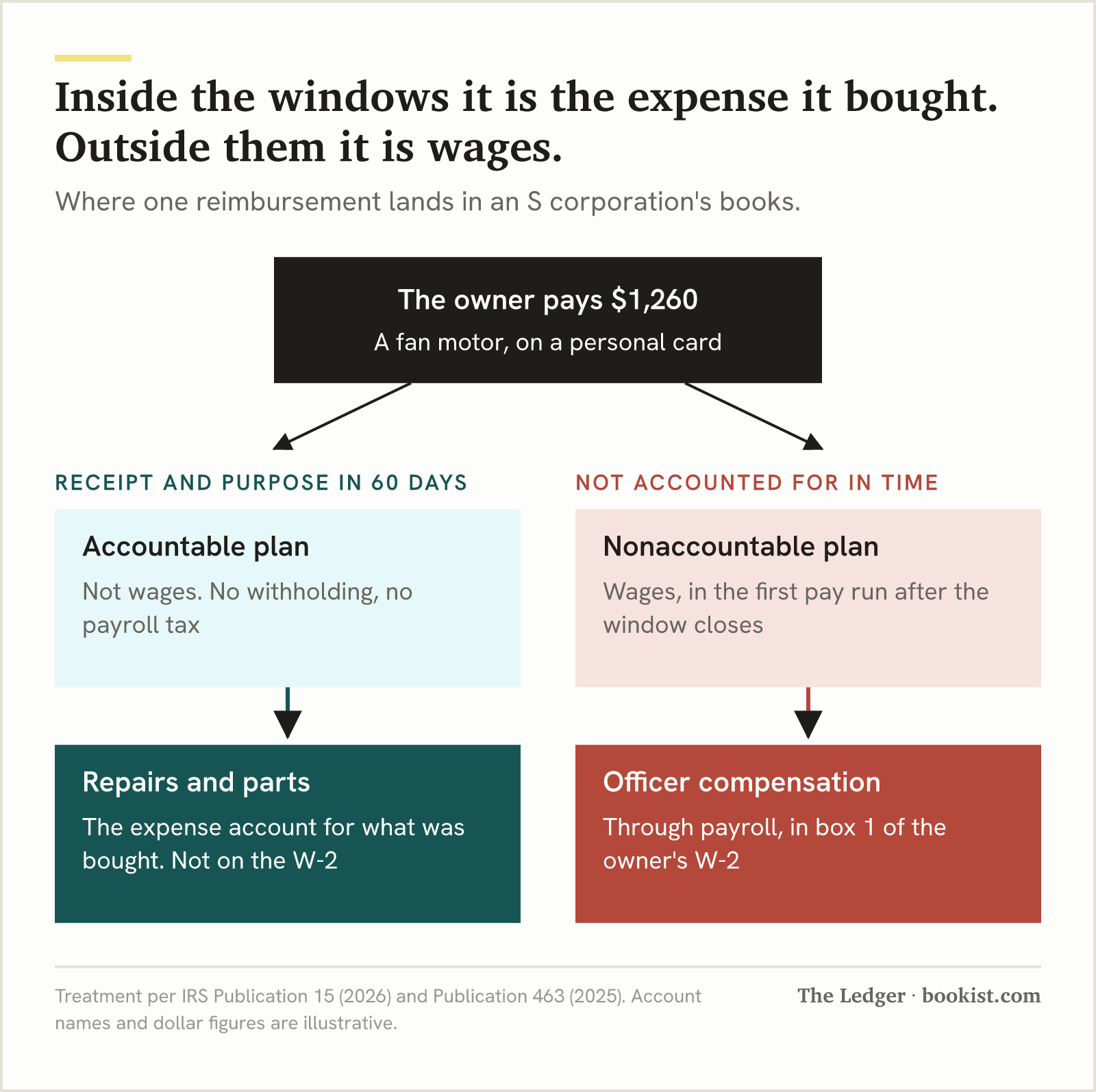
A reimbursement paid under an accountable plan is not wages under Publication 15 (2026), so the books record it in the expense account for what was bought, such as repairs or travel, and it never touches payroll.
An amount not accounted for or returned within its window is treated as paid under a nonaccountable plan and is wages subject to withholding, social security, Medicare and FUTA in the first payroll period after the window ends.
An accountable plan reimbursement turns into wages when the expense is not accounted for, or an excess is not returned, within a reasonable period, which the IRS's fixed date safe harbor sets at 60 days and 120 days after the expense. From then it runs through payroll. Accounted for in time, it is recorded as the expense it paid for. An accountable plan is the set of rules under which a corporation pays an employee back for business costs they paid personally, without the payment counting as wages, and that includes an owner who works in their own S corporation.
The examples below follow a four-person HVAC service company taxed as an S corporation: the owner, who also runs calls, two technicians and an office manager. Every dollar figure and date in them is illustrative. The rules are federal; how your state treats the same payments is not covered here.
What is an accountable plan?
An accountable plan is a reimbursement or allowance arrangement that requires three things of every employee it pays, and Publication 15 (2026), the IRS employer's tax guide, says amounts paid under one are not wages and are not subject to income tax withholding, social security, Medicare or FUTA tax. The three requirements come from the Treasury regulation behind it, 26 CFR §1.62-2:
Business connection. The expense was paid or incurred by the employee in connection with the corporation's business.
Substantiation. The employee accounts for each expense to the corporation within a reasonable period of time.
Return of any excess. Anything paid out beyond the substantiated expenses comes back within a reasonable period of time.
The regulation is strict about the arrangement as a whole. If it does not require all three, everything paid under it is treated as paid under a nonaccountable plan, and Publication 15 (2026) treats nonaccountable payments as wages. That is why the rules are worth reading as a description of what your books have to be able to show, rather than as a form to sign once.
Who can be reimbursed under an accountable plan?
An accountable plan reimburses employees, so it covers a corporation's staff and any owner who is also the corporation's employee. Publication 15 (2026) says people in business for themselves generally aren't employees, but if the business is incorporated, corporate officers who work in the business are employees of the corporation. The owner of the HVAC company, who is its president and runs calls three days a week, is an employee of it.
Two kinds of owner sit outside it. Publication 334 (2025) says a sole proprietor is not an employee of the business, and the IRS says partners, including members of an LLC taxed as a partnership, are self-employed rather than employees when they work for the partnership. For those owners, money the business pays back for something bought personally is a different transaction with different rules, and this article does not cover it. An LLC that has elected S corporation treatment pays its working owner as an employee through payroll, which is what changes in the books the day the election takes effect.
Whether your corporation already has an arrangement that meets these rules, what it should cover, and how its reimbursements are treated on your return are questions for whoever prepares the corporation's return, and they are easier to settle before the year's reimbursements are paid than after. The rest of this article is the part the books carry either way.
How long do you have to substantiate a reimbursement and return the excess?
The IRS treats accounting for an expense within 60 days after it was paid or incurred, and returning any excess within 120 days, as within a reasonable period. Publication 463 (2025), chapter 6, lists these windows, and they are the fixed date safe harbor in §1.62-2(g) of the regulation:
What has to happen | Treated as within a reasonable period when | Example: technician's training trip |
|---|---|---|
An advance is paid | It is received within 30 days before the expense | $600 advance paid April 6 for a trip starting April 13 |
The expense is accounted for | Within 60 days after it was paid or incurred | Receipts and purpose for $455 handed in by June 12 |
Any excess is returned | Within 120 days after the expense was paid or incurred | The unspent $145 back by August 11 |
Publication 463 (2025) also describes a second method. The employer gives each employee a statement at least quarterly asking them to return or account for outstanding advances, and the employee complies within 120 days of that statement. The publication adds that what counts as a reasonable period otherwise depends on the facts and circumstances, so the windows above are the dates that are reasonable without an argument, not the only dates that could be.
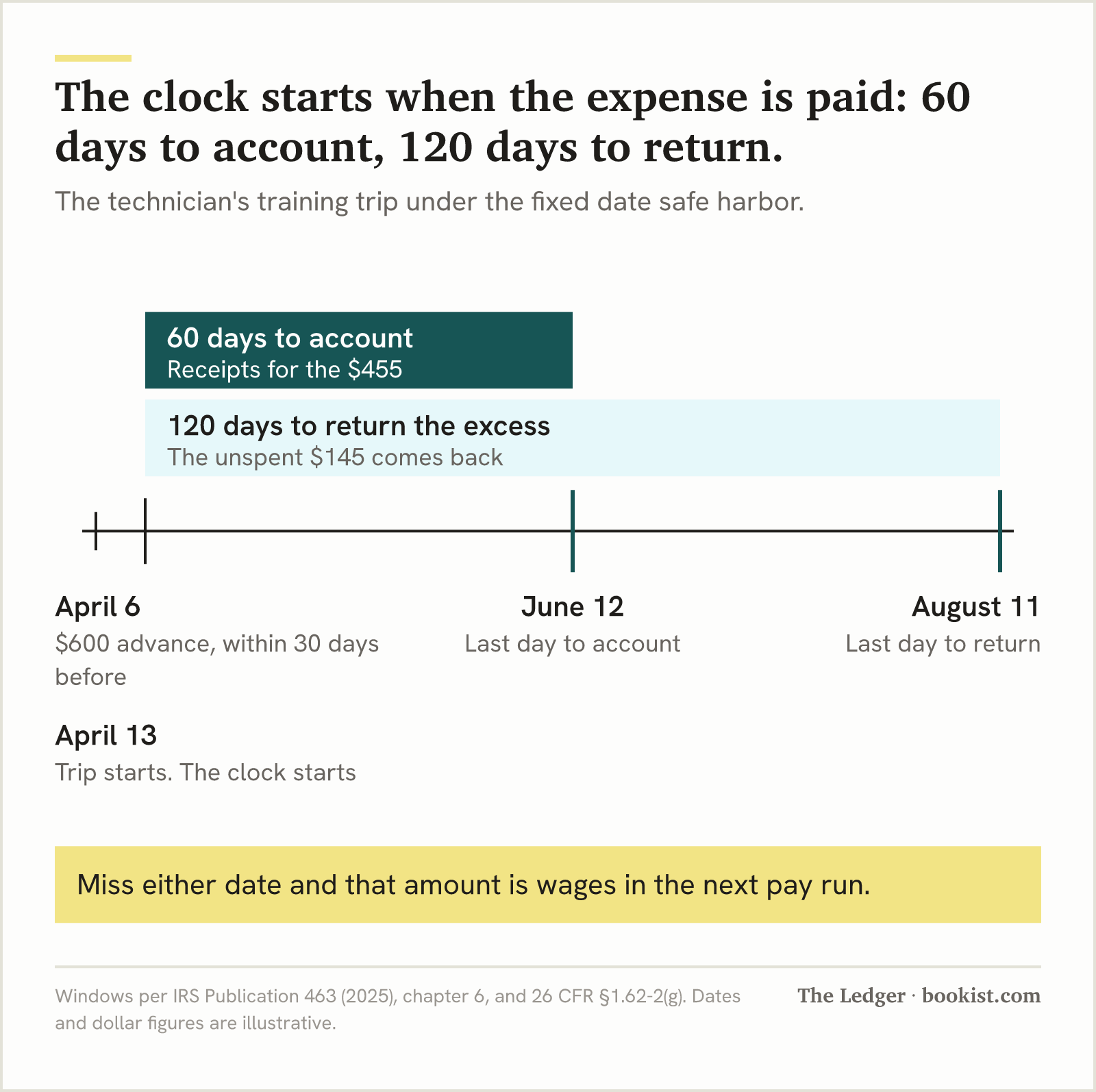
The clock starts on the day the expense was paid or incurred, not on the day someone gets around to the paperwork. A receipt that sits in a van door pocket for nine weeks has already used up the window it needed.
What does each outcome do to the books?
A reimbursement that meets the rules is recorded in the expense account for what was bought and never touches payroll. One that misses them is wages. Between those two ends, the books hold it in one of two places while it waits.
What happens | How the IRS treats the amount | Where it goes in the books |
|---|---|---|
The owner pays $1,260 for a condenser fan motor on a personal card, hands in the receipt and purpose within 60 days, and the corporation pays it back | Paid under an accountable plan: not wages (Publication 15, 2026) | Debit Repairs and parts, credit Cash when paid. Nothing goes to payroll or to the owner's W-2 |
The same receipt is handed in on April 28 but not paid back until May | Still an accountable plan reimbursement | At April's month end: debit Repairs and parts, credit Reimbursements payable, a liability. Cleared when the cash leaves |
A technician is advanced $600 before the trip | Nothing yet: it is an advance | Debit Employee advances, an asset, credit Cash. It is money the employee holds for the business, not an expense |
The technician accounts for $455 within 60 days | Accountable plan | Debit Travel $455, credit Employee advances $455 |
The technician returns the unspent $145 within 120 days | Accountable plan | Debit Cash $145, credit Employee advances $145. The advance account is back to zero |
The $145 is neither returned nor accounted for within 120 days | Treated as paid under a nonaccountable plan; wages subject to income tax withholding, social security, Medicare and FUTA for the first payroll period after the reasonable period ends (Publication 15, 2026) | The $145 leaves Employee advances and is reported to the payroll provider as wages in that pay run. For an officer, it lands in the officer compensation account, not in Travel |
The arrangement never required all three rules | Everything paid under it is nonaccountable (26 CFR §1.62-2) | Every reimbursement belongs in wages, reported through payroll, rather than in the expense accounts it was coded to |
A reimbursement that misses the window does not stop being a cost of the business. It changes which account carries it, and whose W-2 it appears on.
Two details in that table are easy to miss. The regulation applies the failure narrowly: when an employee does not return an excess, only the excess is treated as nonaccountable, not every reimbursement that employee received. And the wage treatment arrives in a specific pay run, the first one after the window closes, so a late amount is something your payroll provider has to be told about before that run rather than discovered at year end. Publication 463 (2025) says amounts paid under a nonaccountable plan are combined with the employee's wages in box 1 of Form W-2.
For the owner of an S corporation, a late reimbursement is officer pay. It belongs in an officer compensation account kept apart from staff wages, the account an S corporation's books keep officer pay in, and the payroll journal entry for that run is the same shape as every other: gross wages to the wage account, withholding and employer taxes to payroll liabilities.
What record does each reimbursement need?
Each reimbursement needs a record made at or near the time of the expense and the document that proves it. Publication 463 (2025) says an employee adequately accounts by giving the employer a statement of expense, an account book, a diary or a similar record entered at or near the time, with documentary evidence such as receipts. The regulation sets the content: for travel and the other expenses covered by section 274(d), the elements that section requires, and for everything else, enough information for the corporation to identify the nature of each expense and connect it to the business.
For travel, Table 5-1 of Publication 463 (2025) names four elements: the amount of each separate expense, the dates of the trip, the destination, and the business purpose. Per diem and mileage allowances have rules of their own and are not covered here.
The record below is one line per expense, and every column is there either because the IRS publications name it or because the books need it to put the amount in the right account.
Field | What it holds | Why it is there |
|---|---|---|
Employee | Who paid, and whether they are an officer | Decides which wage account a late amount lands in |
Date paid or incurred | The day the card was charged or the cash spent | Starts the 60-day and 120-day clocks |
Amount | Each separate expense, from the receipt | Publication 463 (2025): amount of each expense |
What and why | What was bought, for which job or trip, and the business purpose | Business connection, and Publication 463's business purpose element |
Time and place, for travel | Dates away and destination | Publication 463 (2025), Table 5-1 |
Receipt | The document itself, attached to the line | Documentary evidence |
Date accounted for | The day the record and receipt reached the business | Shows the 60-day window was met |
Account coded to | Repairs and parts, Travel, Supplies, and so on | Where the expense lands in the books |
Advance and return | Any advance paid, its date, and the date any excess came back | Shows the 120-day window was met, and clears Employee advances |
Date paid back | When the corporation reimbursed it | Clears Reimbursements payable |
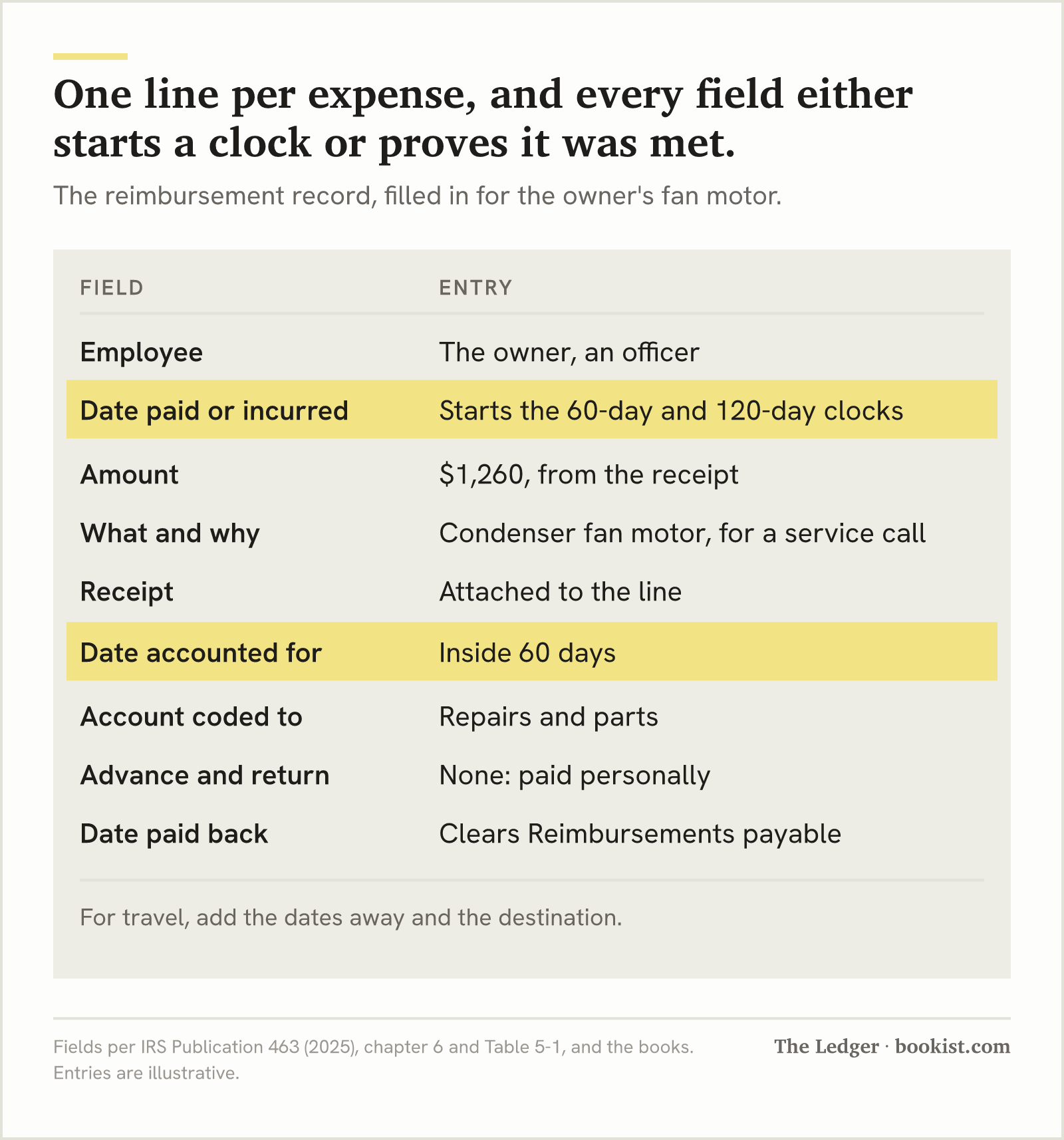
The receipt is the field that goes missing. Keeping the document with the transaction in the accounting file, rather than in an envelope that travels separately, is what lets anyone check later that the date and amount on the record match the receipt.
How do you keep reimbursements inside the windows every month?
You keep them inside the windows by settling every reimbursement at month end, so the oldest open item is never more than about 30 days old when it is looked at. The routine is the same each month:
Collect every record and receipt for business costs paid personally during the month, the owner's included.
Check each line has the date, amount, what and why, and a receipt, and send back any line that does not.
Code each line to the expense account for what was bought, and record anything not yet paid back in Reimbursements payable.
Pay the month's reimbursements, which clears Reimbursements payable.
List every open balance in Employee advances with its 60-day and 120-day dates beside it.
For anything that has passed its window, tell the payroll provider before the next pay run, and move it out of the expense or advance account into wages.

The routine is finished for the month when Employee advances holds only items still inside their windows, Reimbursements payable is zero or holds only the current month, and nothing the owner paid personally is sitting in a draw or distribution account. That last check matters because a business cost the owner paid and was paid back for is neither: it is the expense it bought.
December is the month to run it with care. The reimbursement record is one of the things your accountant needs at year end, and a December expense still inside its window on December 31 sits in Reimbursements payable or Employee advances on the year-end balance sheet, where it can be seen, rather than nowhere.
Pull every business purchase made on a personal card in the last 120 days, the owner's included, and write the date each was paid beside it. Mark which ones already have a receipt and a business purpose recorded. Anything nearing 60 days without both is the one to finish first.
What is the difference between an accountable and a nonaccountable plan?
An accountable plan requires a business connection, substantiation and the return of any excess, and what it pays is not wages; a nonaccountable plan is any arrangement that does not, and what it pays is wages. Publication 15 (2026) says payments under a nonaccountable plan are treated as supplemental wages, subject to income tax withholding, social security, Medicare and FUTA tax. In the books, an accountable plan reimbursement is recorded in the expense account for what was bought, and a nonaccountable payment is recorded as wages and reported through payroll.
Can an S corporation reimburse a home office under an accountable plan?
Whether an S corporation can reimburse an owner-employee's home office under an accountable plan is not addressed in any IRS publication read for this article, so this article does not answer it. How those costs are treated is a question for whoever prepares the corporation's return. What the books need is the same either way: a record of each cost, the date it was paid, and the account it lands in.
Do accountable plan reimbursements have to be paid before year-end?
The IRS timing windows count from the date each expense was paid or incurred, not from the end of the year. Publication 463 (2025) treats accounting within 60 days and returning any excess within 120 days as reasonable, so a December expense is still inside its windows in January. What the year-end changes is the books: a December reimbursement accounted for but not yet paid back sits in Reimbursements payable at December 31, and any advance still open sits in Employee advances, both visible on the balance sheet your preparer reads.
Books where every reimbursement lands in the right account
If you are still working out what your own reimbursements look like, the record and the month-end routine above are yours to use as they are. When you would rather have someone check the coding each month, we are happy to talk it through.
This article explains how the federal accountable plan rules generally work and what they mean for the books. It is not tax advice for your situation.
Operations background across retail, property management, and e-commerce. Writes step-by-step guides for owners who need the answer, not the theory.
Read next

1099 threshold: the part of each vendor's total that counts toward $2,000

Section 179 vs. bonus depreciation: what each election does on the return, and what neither one does to your books