Bookkeeper cost depends more on your books than the rate
A bookkeeper's salary is not what one costs you, and a freelancer's rate is not either. The in-house figure built from BLS data, and the six counts any monthly quote is priced on.

At the May 2025 BLS median wage of $50,670 and with wages at 68.5% of full-time private-industry compensation in June 2026, a full-time in-house bookkeeper costs an employer about $74,000 a year before software or management time.
A freelance bookkeeper costs the hourly rate times the hours your books take, and the hours are set by your transactions, accounts and backlog rather than by the freelancer.
A monthly bookkeeping quote is priced on six counts: transactions, accounts, months behind, scope beyond coding and reconciling, reporting date and review, so two quotes compare only when they price the same counts.
How much a bookkeeper costs depends on which of four ways you buy the work. A full-time employee costs about $74,000 a year at the median once benefits are counted. A freelancer or a monthly service costs whatever your books take to keep: the transactions, the accounts, the backlog and the scope. Your own time has a price too.
The employee figure is built from two Bureau of Labor Statistics releases, shown below. The other three are built from counts you can take off your own books this afternoon. That is the useful part, because the rate is set by a market and the hours are set by you.
How much does an in-house bookkeeper cost?
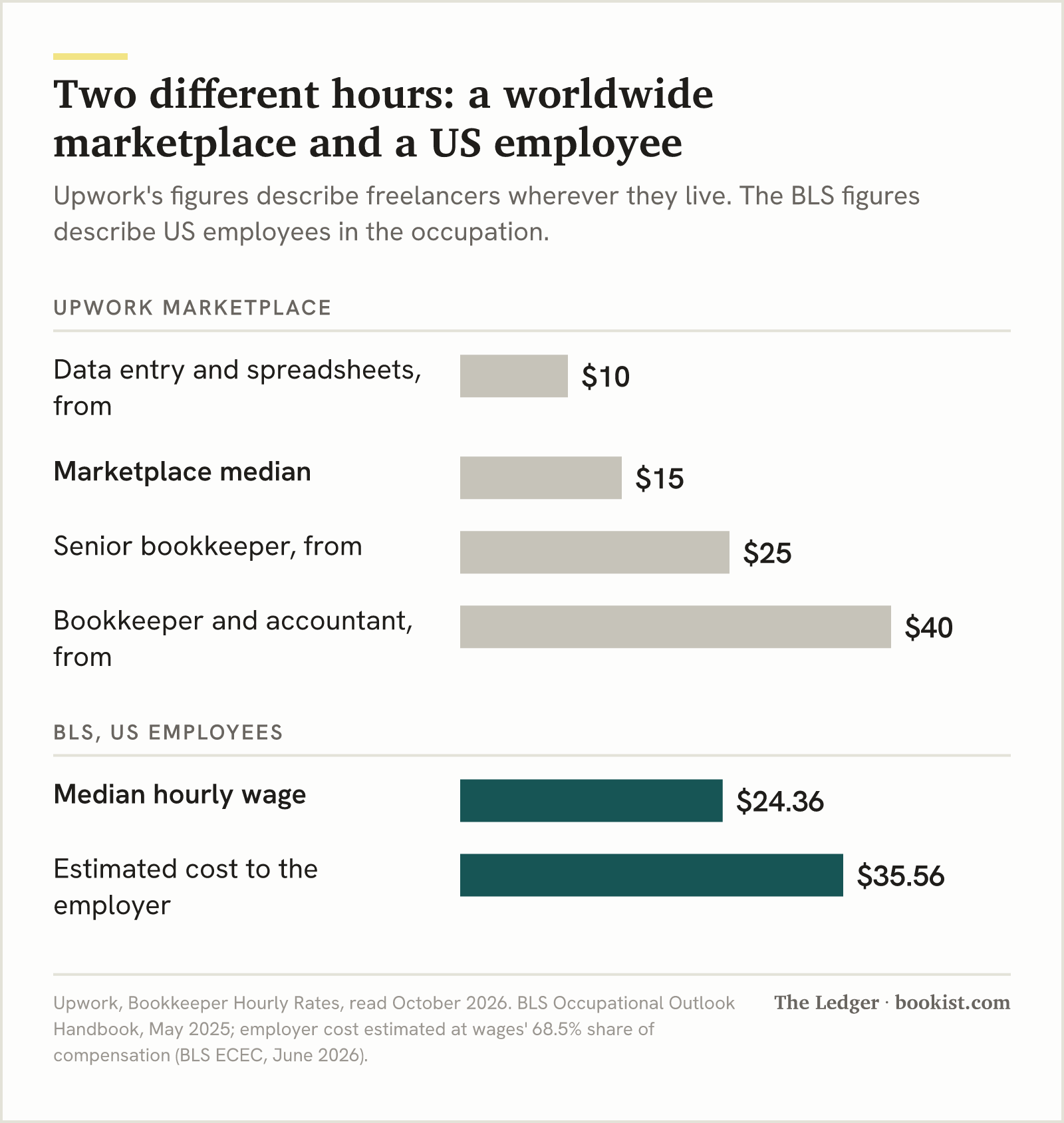
At the May 2025 BLS median wage of $50,670 a year ($24.36 an hour) for bookkeeping, accounting and auditing clerks, and with wages and salaries making up 68.5% of employer compensation costs for full-time private-industry workers in June 2026 (BLS Employer Costs for Employee Compensation, released September 9, 2026), a full-time in-house bookkeeper costs an employer about $74,000 a year, or $35.56 an hour, before software, a desk or the time you spend managing them.
The wage comes from the BLS Occupational Outlook Handbook entry for bookkeeping, accounting and auditing clerks. The ratio comes from the Employer Costs for Employee Compensation release for June 2026, which puts wages at $36.97 of the $54.00 an hour that private employers spent on a full-time worker. The other 31.5% is benefits: paid leave, supplemental pay, insurance, retirement and savings, and the benefits employers are legally required to provide. Dividing the wage by the wage share gives the whole cost.
Step | Annual | Hourly |
|---|---|---|
Median wage, bookkeeping, accounting and auditing clerks, May 2025 | $50,670 | $24.36 |
Divide by wages' share of full-time private-industry compensation, June 2026 | 68.5% | 68.5% |
Estimated cost to employ one full-time bookkeeper | about $73,970 | about $35.56 |
The median is the middle of a wide spread, and the same division works on any point in it. The Handbook puts the lowest 10% of the occupation under $36,000 and the highest 10% over $74,550, and it reports medians for the top industries that employ them.
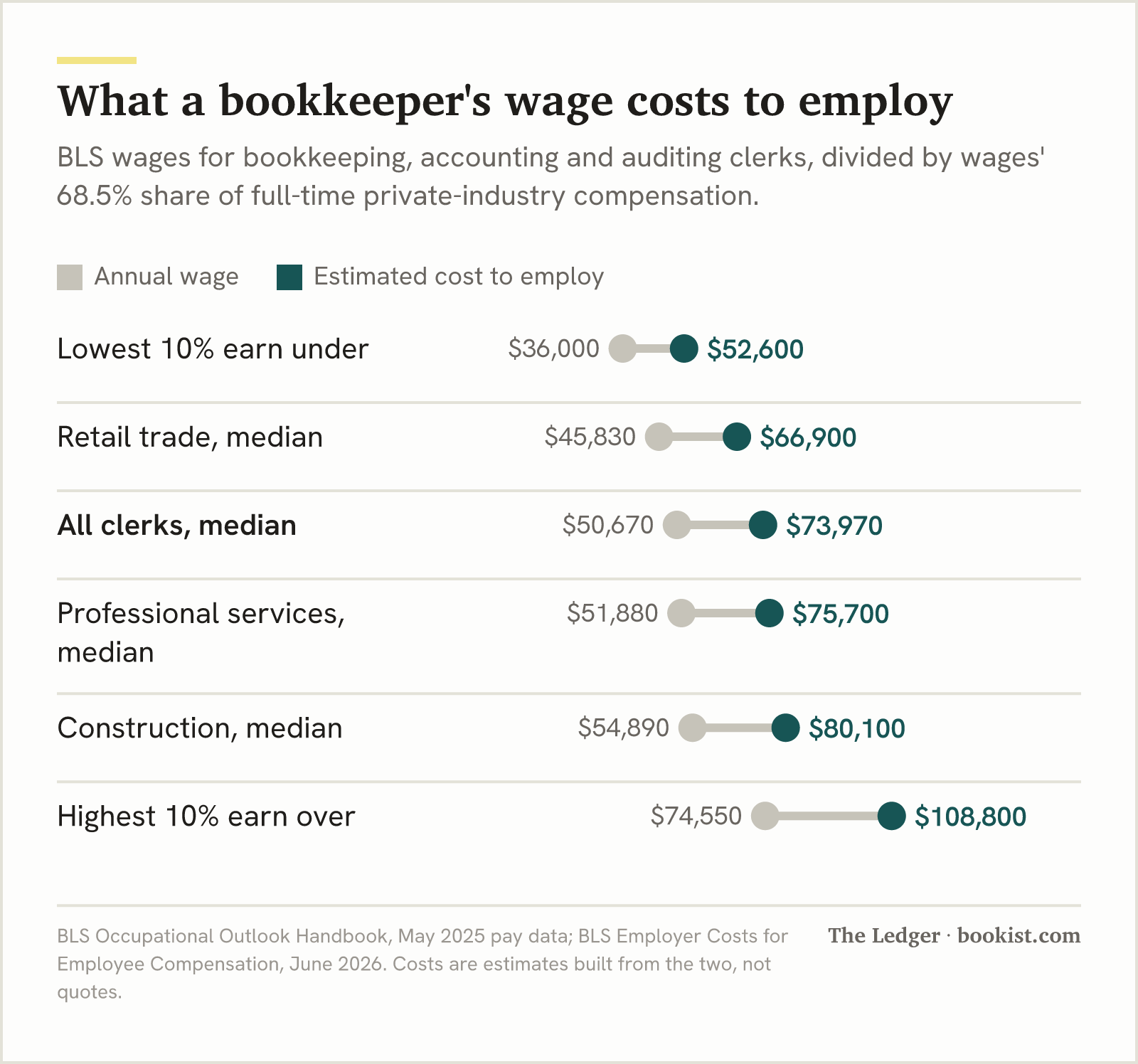
May 2025 wage (BLS) | Wage | Estimated cost to employ at 68.5% |
|---|---|---|
Lowest 10% of the occupation | under $36,000 | under about $52,600 |
Professional, scientific and technical services, median | $51,880 | about $75,700 |
Construction, median | $54,890 | about $80,100 |
Retail trade, median | $45,830 | about $66,900 |
Highest 10% of the occupation | over $74,550 | over about $108,800 |
The 68.5% is an average across every full-time job in private industry, not a figure measured for bookkeepers alone, so the result is an estimate built from two published numbers rather than a quote. If you already employ people, your own ratio is the better divisor: take what your payroll costs you in total, including the employer taxes and benefits, and see what share of it is wages.
A full-time hire is the wrong shape when the books do not fill 40 hours a week. The Handbook says most bookkeeping clerks work full time and some work part time, and a part-time employee is still an employee: someone on your payroll, working to a job you define and supervise. The in-house option earns its cost when there is a day's work in the books every day and you want the person doing it in the room.
What does a freelance bookkeeper charge per hour, and what does the rate leave out?
Upwork's bookkeeper cost page, read in October 2026, gives a median of $15 an hour on its marketplace and a typical range of $11 to $25. The same page shows rates rising with skill: from $10 an hour for data entry and spreadsheet work, from $25 for a senior bookkeeper with some accounting skills, and from $40 for someone working as both bookkeeper and accountant.
Read that median for what it measures. Upwork's page says location affects rates and that bookkeepers can work remotely from their own location, so the figure describes a marketplace open to freelancers wherever they live. It is not a US wage, and it sits below the $24.36 hourly median BLS reports for US employees in the same occupation before any benefits are added.
The rate is half of the price. The other half is hours, and your books set those. Take a five-person design studio with two bank accounts, three credit cards and about 300 transactions a month, and suppose the month takes eight hours to code and reconcile. At $25 an hour that month costs $200, and at $40 it costs $320. Add a payment processor whose deposits bundle fees and refunds into one line, or let three months slide, and the hours move while the rate stays where it was. Every figure in that example is illustrative.
Hourly work is the wrong shape when nobody checks the result, because an hourly bill tells you how long the work took and nothing about whether it is right. The check is the set of documents the work leaves behind, and what a bookkeeper should hand you every month is a list of nine, each one a report you can open.
What sets the price of a monthly bookkeeping service?
A monthly bookkeeping service prices the work your books generate, and six things about your books set it: transaction volume, the number of accounts, how far behind the file is, what the work includes beyond coding and reconciling, how soon you need the reports, and who reviews the work before it reaches you.
This page gives no dollar range for monthly fees. The published ranges come from firms pricing their own category, and none we could read carried both a date and a source that could be named in the sentence. A range without either tells you less than the six counts below, which are what any quote is built from.
What drives the price | Why it moves the fee | What to count before you ask |
|---|---|---|
Transactions a month | Every line on a bank or card feed has to be coded to an account and matched | The lines on last month's bank and card statements, added together |
Accounts | Each bank account, card, loan and payment processor is reconciled to its own statement every month | One line per account, dormant ones included |
Months behind | A backlog is a separate job and is priced separately from the monthly work | The last month that reconciled to a statement, and how far behind the file already is from there |
Scope beyond coding and reconciling | Payroll journal entries, sales tax in more than one state, inventory, accrual adjustments and class or location tracking each add work every month | Which of those your books carry today |
Reporting date | An early fixed date needs your inputs earlier, and someone holding the date | The working day you want last month's reports by |
Review | Work a second person checks before it reaches you takes more time to produce than work nobody checks | Who reviews it, and what they look at |
When two quotes differ, ask each one which of these counts it was priced on. Two quotes built on different counts are not comparable until they are built on the same ones.
Some services pair software that proposes the coding with an accountant who reviews it before it reaches you. Which decisions that automation can make and which still need a person is the question to put to any service working that way, Bookist included. If you are weighing Bookist itself, what Bookist charges for monthly bookkeeping is published on its own page and kept current there rather than in an article.
What does doing your own bookkeeping actually cost?
Doing your own bookkeeping costs the ledger subscription plus your hours, and the hours are only expensive if they would otherwise go to work that earns.
You can price yours in two numbers. Count the hours the books took last month, including the evening spent looking for one receipt. Then multiply by what an hour of yours is worth to the business: your billing rate if you sell your time, or the value of the work that waited if you do not.

Here is an illustration, not a finding. An architect who bills $150 an hour and spends 10 hours a month on the books is spending $1,500 a month of billable time on them. The same 10 hours at the estimated $35.56 an hour it costs to employ a median bookkeeper is about $356. The gap between those two numbers is the whole case for or against doing it yourself, and only you know your own inputs.
Doing it yourself is the right answer when the books are current, the accounts are few, and you want to see every transaction go through. Nobody codes a transaction faster than the person who remembers what it was for. It is the wrong answer when the books are the last job of every month and the month keeps ending before they are done.
Which way of paying for bookkeeping fits a business your size?
The way of paying that fits is the one whose price is set by something you can count today. Five ways, side by side:
Option | How you pay | What sets the price | Wrong for |
|---|---|---|---|
Doing it yourself | A ledger subscription and your hours | Your hours times what an hour of yours earns | Owners whose month ends before the books do |
Freelance, hourly | Per hour billed | The rate times the hours your books take | Owners with nobody checking the work |
Monthly service | A fixed monthly fee | The six counts above | Owners who want to make every categorization call themselves |
Part-time employee | Wages plus employer costs, for the hours worked | Hours times the loaded hourly cost | Books without steady weekly work, or nobody to supervise it |
Full-time employee | Salary plus benefits | About $74,000 a year at the May 2025 BLS median | Books that do not fill 40 hours a week |
The rate is what a market charges. The hours are what your books cost, and you can count those before anyone quotes you.
How do you compare bookkeeping quotes?
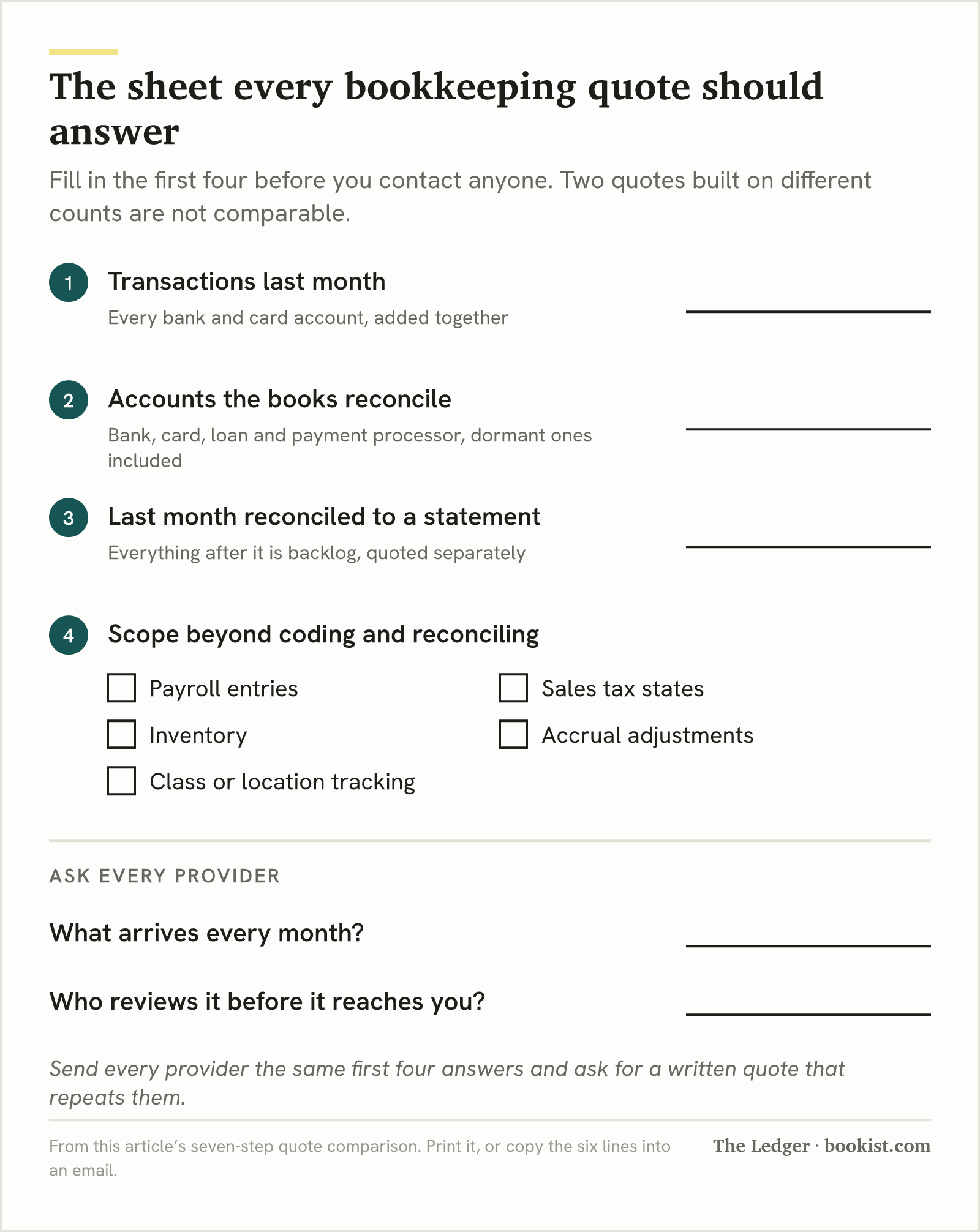
You compare bookkeeping quotes by giving every provider the same counts and asking each to state them back. Seven steps, and the first four are done before anyone is contacted.
Count last month's transactions across every bank and card account.
List every account the books reconcile: bank, card, loan and payment processor.
Write down the last month that reconciled to a statement. Everything after it is backlog, and it is quoted separately from the monthly work.
Name the scope beyond coding and reconciling: payroll entries, sales tax states, inventory, accrual adjustments, class tracking.
Send every provider the same four answers and ask for a written quote that repeats them.
Ask each what arrives every month and who reviews it before it does.
Set each monthly figure beside your own: your hours at your rate, or the same hours at an employee's loaded hourly cost.
You are done when every quote names the same counts and the same deliverables, and each one sits next to the number it is replacing.
Export last month's bank and credit card transactions and count the lines. Write that number beside the number of accounts you reconcile and the last month that reconciled to a statement. Those three numbers are what every bookkeeping quote is priced on, and with them in hand you can check any quote you get.
How much does a bookkeeper cost per month?
A full-time bookkeeper employee costs an employer about $6,160 a month at the May 2025 BLS median wage of $50,670, once wages are treated as 68.5% of total compensation, the share BLS reported for full-time private-industry workers in June 2026. A freelancer's monthly cost is their hourly rate times the hours your books take. A monthly bookkeeping service quotes on your transaction count, accounts, months behind and scope, so the same service can price two businesses very differently.
How much does a bookkeeper cost per hour?
A US bookkeeping, accounting and auditing clerk earned a median of $24.36 an hour in May 2025, according to the BLS Occupational Outlook Handbook, which is about $35.56 an hour to the employer once benefits are counted at the June 2026 ratio for full-time private-industry workers. On Upwork's freelance marketplace, its bookkeeper cost page, read in October 2026, gives a median of $15 an hour and a typical range of $11 to $25, across freelancers working from many locations.
Should I hire a bookkeeper, use software, or do it myself?
That turns on three counts: how many hours the books take you each month, what those hours would otherwise earn, and whether anyone checks the work. Accounting software proposes categories and produces reports, and someone still has to decide what each ambiguous payment was and reconcile every account to its statement. If the books are current and the hours are few, doing it yourself costs the least. If the hours are many, compare them at your own rate with a quote built on your transaction count, accounts and backlog.
Get your month-end hours back
Bookist keeps the books every month: automation handles the monthly bookkeeping and an accountant reviews it before it reaches you. Bring last month's transaction count and your list of accounts to a call, and we will tell you plainly whether handing the work over fits your books.
This article explains how bookkeeping costs are generally built. The employee figures are estimates from published BLS data, not a quote, and nothing here is tax or employment advice for your situation.
Has migrated more companies off legacy accounting systems than he'd like to admit. Reviews the tools, integrations, and duct tape holding modern finance stacks together.