Reconcile your budget vs actual to the cash that left your account
A month can beat its budget and still leave the bank lower than it started. Four outflows never reach a profit and loss budget, and an eight-row bridge shows which one took the cash.

A profit and loss budget vs actual report compares income and expense accounts, so a month can come in on budget while the bank balance falls.
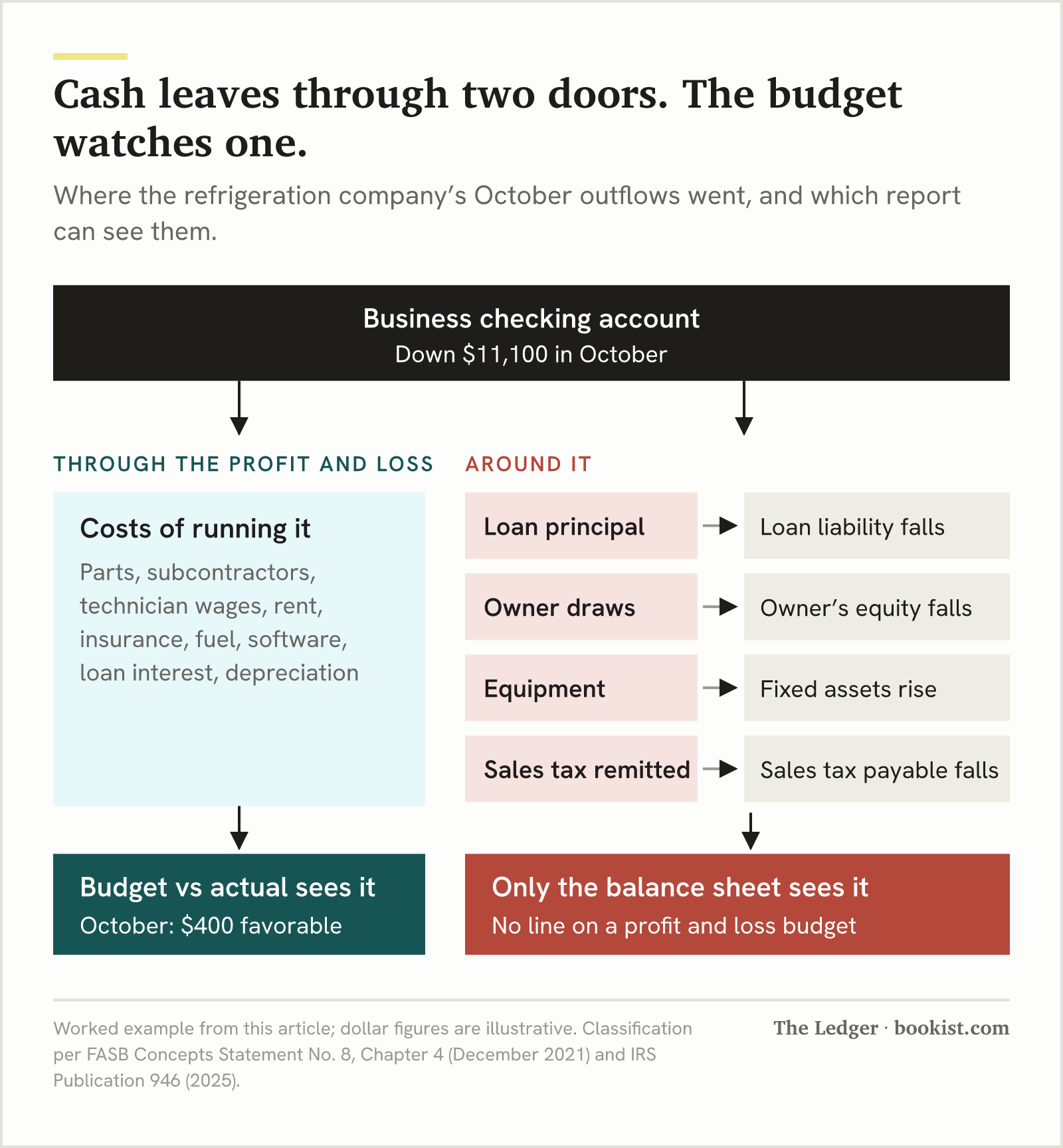
Loan principal, owner draws, equipment capitalized as a fixed asset and sales tax remitted all move cash without being income or expense, which is why none of them appears on a profit and loss budget.
Starting from actual net income, adding back depreciation and adding or subtracting the month's change in loans, draws, fixed assets, sales tax payable and, on accrual books, receivables and payables reconciles the budget to the change in the bank balance.
A budget vs actual report compares the income and expenses you planned with the ones you recorded, so it can show a month on budget while your bank balance fell. Four outflows never reach it: loan principal, owner draws, equipment you capitalized and sales tax you remitted. Reconcile the report to the bank with one short bridge and the gap gets a name.
The worked month below belongs to a three-van commercial refrigeration and HVAC company whose customers are restaurants, the kind of service business that buys parts and bills for jobs. Every dollar figure is illustrative.
What does a budget vs actual report compare?
A budget vs actual report lines up each income and expense account against the amount you budgeted for it and shows the difference, called the variance. Revenue above budget or costs below it is a favorable variance. The reverse is unfavorable.
Both of the ledgers this reader uses describe it in those terms. Intuit's help article Create budgets in QuickBooks Online, read in October 2026, describes the point of a budget as comparing your actual income and expenses against it. Xero's help page for its Budget Variance report, read the same month, says the report compares your actual revenue and expenses with budgeted amounts.
Here is October for the refrigeration company, as its profit and loss budget vs actual prints it.
Line | Budget | Actual | Variance |
|---|---|---|---|
Revenue | $96,000 | $97,500 | $1,500 favorable |
Cost of jobs: parts, subcontractors, technician wages | $52,000 | $53,100 | $1,100 unfavorable |
Overhead: rent, insurance, fuel, software, loan interest | $24,800 | $24,800 | none |
Depreciation | $1,200 | $1,200 | none |
Net income | $18,000 | $18,400 | $400 favorable |
Every line is within about 2% of plan. By the report, October was a good month. The business checking account finished it $11,100 lower than it started.
Why can a month come in on budget and leave less cash?
A month comes in on budget and leaves less cash when money leaves the business through transactions that are not income or expense. A profit and loss budget only has lines for income and expense, so those payments have nowhere to appear. Four of them have an account you can read the month's figure from.
Outflow | Where your books record it | Why the profit and loss budget never sees it | Where to read the month's figure |
|---|---|---|---|
Loan principal | A reduction in the loan liability on the balance sheet | It repays money you borrowed. Only the interest part of the payment is an expense | The change in each loan account between two month-end balance sheets |
Owner draws | A reduction in owner's equity | It is a distribution to the owner, not a cost of running the business | The draws or distributions account in the equity section |
Equipment capitalized | A fixed asset on the balance sheet | It reaches the profit and loss slowly, as depreciation, over the years you use it | The increase in fixed assets at cost |
Sales tax remitted | A reduction in sales tax payable | It was never your income, so paying it over is not your expense | The change in the sales tax payable account |
Each row rests on a definition rather than a convention. FASB's Concepts Statement No. 8, Chapter 4 (December 2021) defines a liability as a present obligation to transfer an economic benefit, and says that borrowing cash obligates an entity to repay the amount borrowed, so a principal payment settles an obligation rather than using anything up. The same chapter defines distributions to owners as decreases in equity, and excludes them from comprehensive income altogether. That is why only one part of a loan payment lands on the profit and loss, and why a draw never does.
Equipment works on a delay. IRS Publication 946 (2025) describes depreciation as recovering the cost of property over the time you use it, for property whose useful life extends substantially beyond the year you put it in service. The cash leaves the day you pay the invoice. The expense arrives in slices. Which purchases your books expense at once and which they capitalize is set by your own policy, and the de minimis safe harbor and the capitalization policy behind it decide most of the small ones.

Sales tax is the one that sits in your account longest before it leaves. Colorado's Department of Revenue states the position plainly in its Sales Tax Guide: sales tax a customer pays to a retailer is public money and the property of the state, held in trust until it is remitted. Other states word it differently, so check your own state's department of revenue, but recorded correctly the tax goes to a liability when you collect it and comes out of the liability when you pay it. Neither event touches income or expense.
On budget and out of cash is not a contradiction. It is two reports measuring two different things, and the gap between them has four names.
How do you reconcile budget vs actual to the bank balance?
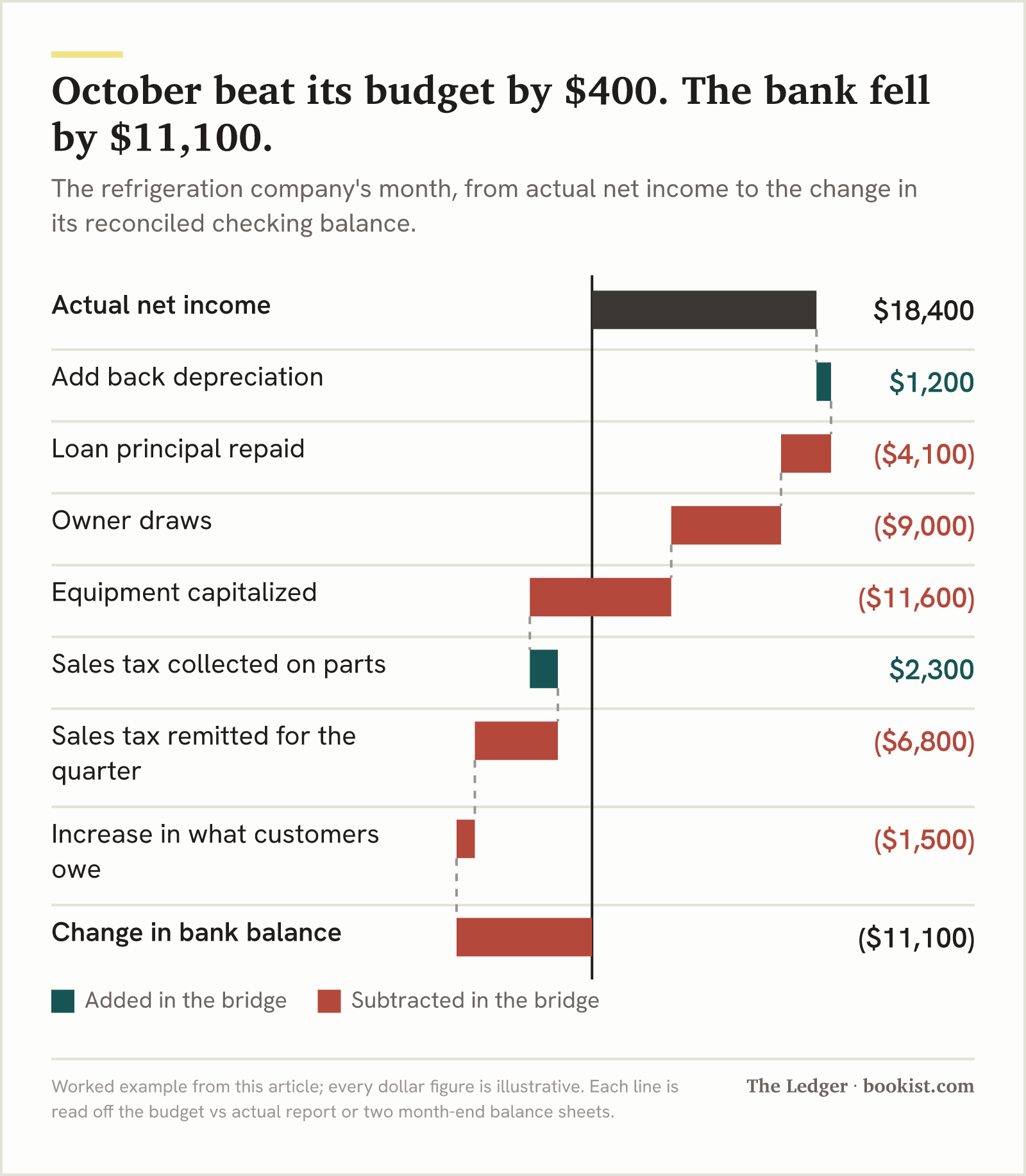
You reconcile budget vs actual to the bank by starting from actual net income, adding back what was expensed without cash leaving, and then adding or subtracting the movement in each balance sheet account the budget does not cover. The result should equal the change in your reconciled bank balance. Here is the refrigeration company's October.
Bridge line | Amount | Where it comes from |
|---|---|---|
Actual net income | $18,400 | Bottom line of the budget vs actual report |
Add back depreciation | $1,200 | Depreciation line on the same report. An expense no cash left for this month |
Less loan principal repaid | ($4,100) | Van loan balance fell from $86,300 to $82,200 |
Less owner draws | ($9,000) | Owner's draw account, October movement |
Less equipment capitalized | ($11,600) | A refrigerant recovery machine and a leak detector, paid in full, added to fixed assets |
Add sales tax collected on parts | $2,300 | Increase in sales tax payable from October invoices |
Less sales tax remitted for the quarter | ($6,800) | Payment to the state, out of sales tax payable |
Less increase in what customers owe | ($1,500) | Accounts receivable rose, on accrual books only |
Change in bank balance | ($11,100) | Reconciled checking balance, October 31 against September 30 |
The month beat its budget by $400 and the bank fell by $11,100. Nothing went wrong. The owner bought equipment, paid the quarter's sales tax and took a normal draw in the same four weeks, and none of the three is a line on the budget.
Run it on your own books in this order:
Run budget vs actual for the month and write down actual net income.
Run two balance sheets, dated the last day of this month and the last day of last month, and put them side by side.
For each loan, subtract this month's balance from last month's. A fall is principal repaid. A rise means new borrowing came in, and it goes in as an addition.
Take this month's movement in the owner's draw or distributions account. An owner contribution goes in as an addition.
Take the increase in fixed assets at cost, then add back the month's depreciation from the profit and loss.
Take the change in sales tax payable. It already nets what you collected against what you remitted.
On accrual books, take the change in accounts receivable and accounts payable. Receivables going up is cash you have not collected yet; payables going up is cash you have not paid yet. On cash books, skip this step.
Add it up and compare it with the change in your reconciled bank balance.
If the bridge does not land on the bank figure, the remainder is a balance sheet account this list does not name, such as a credit card balance or a prepaid insurance policy, or a bank account that has not been reconciled. The bridge only works on a balance sheet reconciled every month, because every row after the first is read off it.
Pull last month's budget vs actual and two month-end balance sheets, and fill in the eight rows above with your own figures. If the result matches your bank, you now know which of the four took the cash. If it does not, the remainder tells you which account to look at first.
How do you put the four outflows into next year's budget?
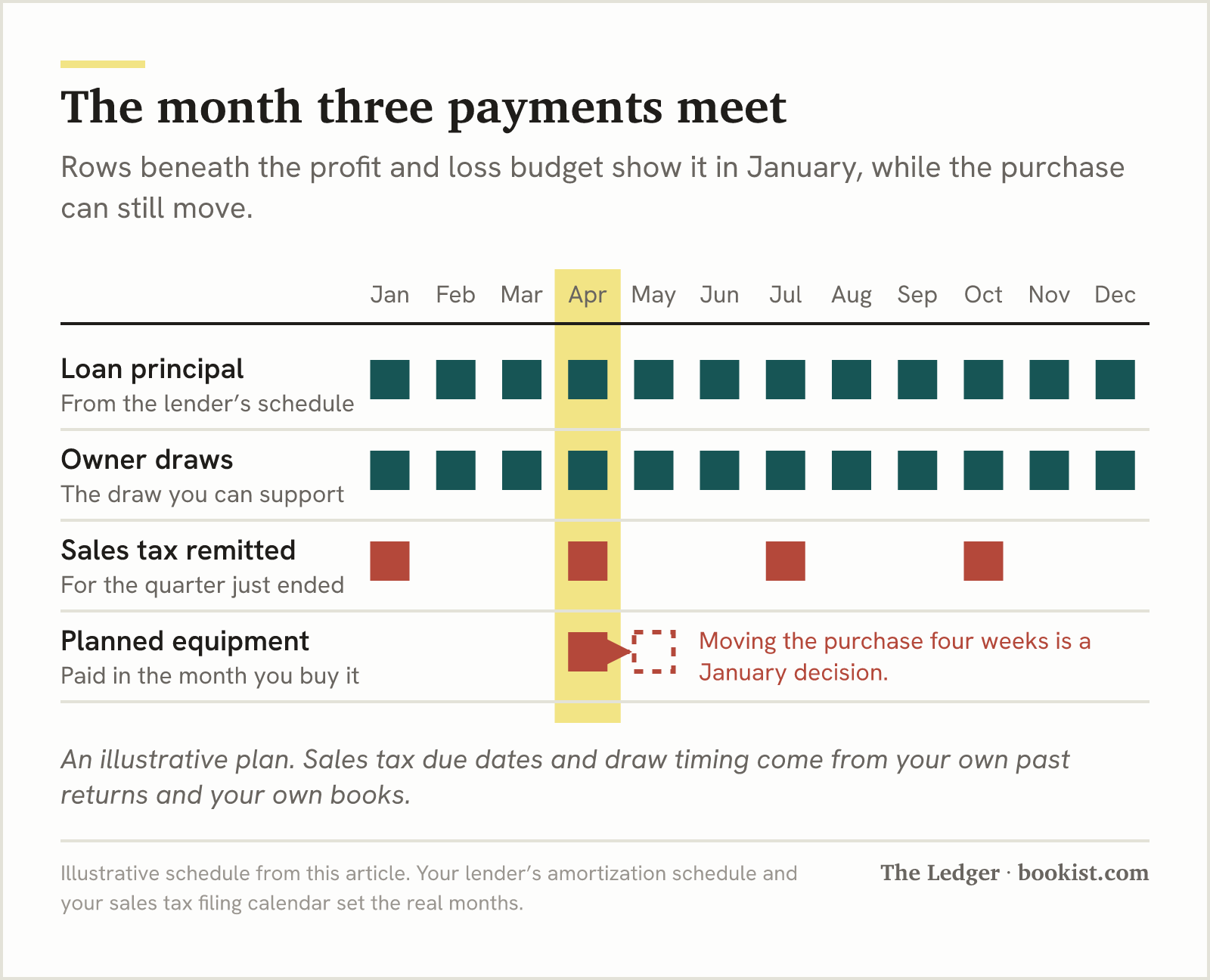
You put the four outflows into a budget by adding rows for them beneath the profit and loss, so the plan ends at a cash figure instead of at net income. Each of them can be scheduled before the month starts, which revenue cannot.
Row | How to size it for each month |
|---|---|
Loan principal | The amortization schedule from the lender gives principal and interest for every payment. The interest is already in your expense budget; the principal goes here |
Owner draws | The draw you can actually support, after the tax reserve and the cash floor. Reserve, floor, draw is how to work that number out from your own books |
Equipment purchases | The purchases you already know are coming, in the month you expect to pay for them, not the months they will be depreciated |
Sales tax | Collections in the months you invoice, and the remittance in the month it is due, using the schedule your own past returns show |
QuickBooks Online also lets you build a balance sheet budget alongside a profit and loss one, according to the same Intuit help article. That is the native place to plan loan balances and equity. The rows above do the same job in whatever spreadsheet you already keep, and they do it in the order you will feel them.
The useful thing this changes is the timing of the controllable rows. Draws and equipment are the two you decide. If the plan shows a quarter-end sales tax payment, a loan payment and a planned equipment purchase landing in the same month, moving the purchase or the draw by four weeks is a decision you can make in January rather than discover in April. Whether to finance a purchase or pay cash for it is a question for you and whoever advises you on borrowing. What the budget can do is show you the month it lands.
What is the difference between a budget, a forecast and actuals?
A budget is the plan you set before the period starts, a forecast is your current estimate of how the period will end, and actuals are what your books recorded. The budget stays fixed so the variance means something. The forecast moves as the year does. A budget vs actual report compares the first with the third, and a forecast vs actual report compares the second with the third. When all three are built on the profit and loss, all three miss the cash that left through loan principal, owner draws, capitalized equipment and sales tax.
How do I create a budget for a small business?
A small business budget is most reliable when it starts from your own last 12 months of actuals, month by month, rather than from a percentage someone else published. Export a monthly profit and loss for the past year, adjust each line for what you already know will change, such as a new hire, a rent increase or a contract that ended, and keep the seasonal shape your own history shows. Then add the four cash rows beneath it: loan principal, owner draws, planned equipment purchases and sales tax. A budget that stops at net income tells you whether the year should be profitable. One that ends at cash tells you whether you can afford it month by month.
Know which line took the cash before you plan the next draw
If your budget vs actual and your bank balance keep telling different stories, a short conversation about how your books record loans, draws, equipment and sales tax usually finds the reason. Bring last month's reports and we will read them with you.
This article explains how budget reports and the books generally work. It is not tax, legal or financing advice for your situation.
Former FP&A analyst who now reads P&Ls the way other people read box scores. Covers spend patterns, margin trends, and what the numbers say before the owner notices.