Match the documents needed for a business loan to the returns you filed
Every lender's list asks for the same financials. What the lists leave out is that your statements, your bank, your loans and the returns you filed all have to tell the lender the same story.

A business loan package is your tax returns, year-end and year-to-date profit and loss and balance sheets, bank statements, a debt schedule, aging reports and the owners' personal financial details, with the lender setting how many years and months.
With the borrower's approval on IRS Form 4506-C or in an IRS online account, a lender can order transcripts of the business's filed returns from the IRS, so year-end statements that differ from the returns need a written explanation.
For an SBA 7(a) loan, each individual who owns 20% or more of the business gives an unlimited personal guaranty on SBA Form 148, alongside SBA Form 1919 and a personal financial statement.
The documents needed for a business loan come down to one set of financials and the paperwork behind them. Your business tax returns. A profit and loss and a balance sheet for each of those years, and the same two reports for this year so far. Recent bank statements. A list of everything the business owes. The owners' personal financial details. The lender says how many years and months.
What those lists leave out is that the pieces have to agree. The profit on last year's statement should match the return you filed. The cash on the balance sheet should match the bank statement for the same day. The loans should match what each lender says you owe. With your approval, a lender can get transcripts of your filed returns straight from the IRS, so a difference nobody can explain becomes the first question about your application. Cut every report from your books on one date, check those three things, and write down the reason for any gap before you send anything.
What documents do lenders ask for, and what does each one have to show?
Each document answers one question for the lender, and most of them come out of your own books. The rest come from your preparer, your bank and your lenders, and those have to agree with the books.
Read down the third column before you gather anything. It tells you which report to run and who to ask for the rest.
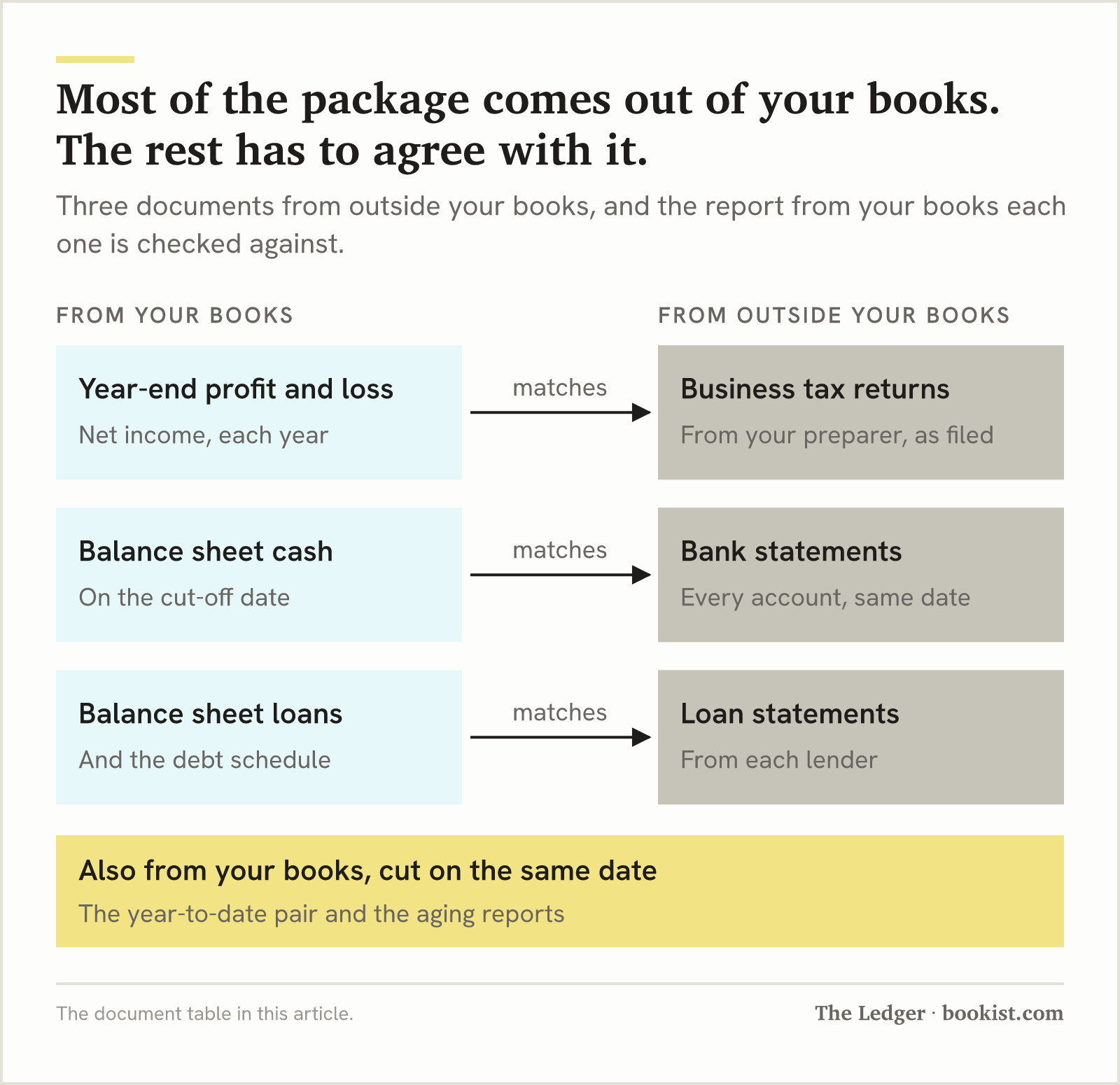
Document | What it has to show the lender | Where it comes from | The one check before you send it |
|---|---|---|---|
Business tax returns | What the business reported to the IRS, year by year | Your preparer, as filed | It is the signed, filed version, not a draft |
Year-end profit and loss, for each of those years | What the business earned and spent, in more detail than the return | Your books, run for each full year | Net income agrees with the return, or the difference has a written reason |
Year-end balance sheet, for each of those years | What the business owned and owed on the last day of the year | Your books, as of each year end | Cash matches the December bank statement |
Year-to-date profit and loss and balance sheet | How this year is going, cut on one recent date | Your books, through the last month you have closed | Both reports carry the same date, and the bank accounts are reconciled to it |
Business bank statements | That the money in the reports actually moved through the bank | Your bank, every page, every account | The closing balance equals the cash on your balance sheet for the same date |
Debt schedule | Every loan, line of credit, lease and financed purchase, with balance, payment and end date | Your loan statements, checked against the balance sheet | Each balance matches the lender's statement and the loan lines on your balance sheet |
Accounts receivable and payable aging | Who owes you, who you owe, and how long each has been open | Your books, run on the same date as the balance sheet | The totals equal receivables and payables on the balance sheet |
Owners' personal financial statement and personal returns | What each owner who would guarantee the loan owns and owes | Each owner | It covers everyone the lender names, dated recently |
Entity and ownership documents | That the business exists as named and who owns how much | Your formation papers and state filings | The legal name matches the returns and the bank account |
The aging reports are the row with the most to say about cash still to come. The total tells them how much of your balance sheet is money still to come in, and the columns tell them how old it is. What the oldest column of an aging report means is worth knowing before a lender asks about it.
The profit and loss and the balance sheet are asked for as a pair, cut on one date, because each checks the other. How one statement feeds the other is why a lender will not take either on its own.
Why do my financial statements have to match my tax returns?
Because the lender can check your filed returns without relying on the copies you send. The IRS runs a service that lets banks, credit unions and other lenders order transcripts of your tax returns for income verification, and it sends them only if you approve the request. You give that approval by signing IRS Form 4506-C, or in your IRS online account. A statement from your books that shows more profit than the return you filed is then a question the lender has to resolve before it can rely on anything else in the package.
A difference is not a problem in itself. Books and returns can differ for ordinary reasons. A difference you cannot explain is a problem, because the lender has no way to tell an honest adjustment from a statement that was dressed up.
One source of a gap is work your preparer did after your books closed. A preparer finishing the return may adjust inventory to the year-end count, add depreciation the return allows, or move an expense between categories. If those adjustments never come back into your books, your year-end profit and loss and the return describe the same year differently, and they stay different every time you print the report.

The fix is a conversation, not a recalculation. Ask whoever prepared the return for the adjustments they made, and post them, or have your bookkeeper post them, so the books match the return. Where a difference is meant to stay, such as depreciation taken faster on the return than in the books, write one line explaining it and put it in the package beside that year.
A lender does not have to take your word for last year. With your approval, it can read a transcript of the return you filed, straight from the IRS.
How do I put the package together from my books?
Ask the lender for its list first, then produce everything from your books as of one date. Every lender's list differs a little in how many years, how many months of statements and which forms, and asking costs nothing. Then work through it in this order.
Get the lender's list in writing. How many years of returns and statements, how many months of bank statements, and which of their own forms they need.
Close the books through the last full month. Reconcile every bank account, card and loan to its statement for that month. That month end becomes the date on everything you send.
Run the year-end reports. A profit and loss and a balance sheet for each year the lender asked for, from your books rather than from the return.
Put each year beside its return. Compare net income on the profit and loss with the return. Note any difference, and get it explained or posted, as in the section above.
Run the year-to-date pair. A profit and loss from the start of the year to your chosen month end, and a balance sheet on that same day.
Build the debt schedule from the loan statements. One line per loan, line of credit, lease and financed purchase: who it is with, the balance, the monthly payment, and when it ends. Check each balance against the balance sheet.
Run the aging reports on the same date. Receivables and payables, with totals that match the balance sheet.
Download the bank statements for every business account, every page, for the months the lender asked for.
Collect the owners' documents. Personal financial statements, personal returns and identification for each owner the lender names.
Name every file the same way. The document, the period and the date it was cut, so the lender can tell what each one is without opening it.
You are done when every report carries the same cut-off date, each year's profit matches its return or has a written reason beside it, the cash on the balance sheet equals the bank statement, and every loan on the debt schedule agrees with both the lender's statement and the balance sheet. A package in that state answers the lender's first round of questions before anyone asks them.
What does that look like for a small online shop?
Here is a three-person online shop selling kitchenware, putting a package together in November 2026 to apply for a line of credit ahead of its busiest season. The business, its figures and its lender are illustrative.
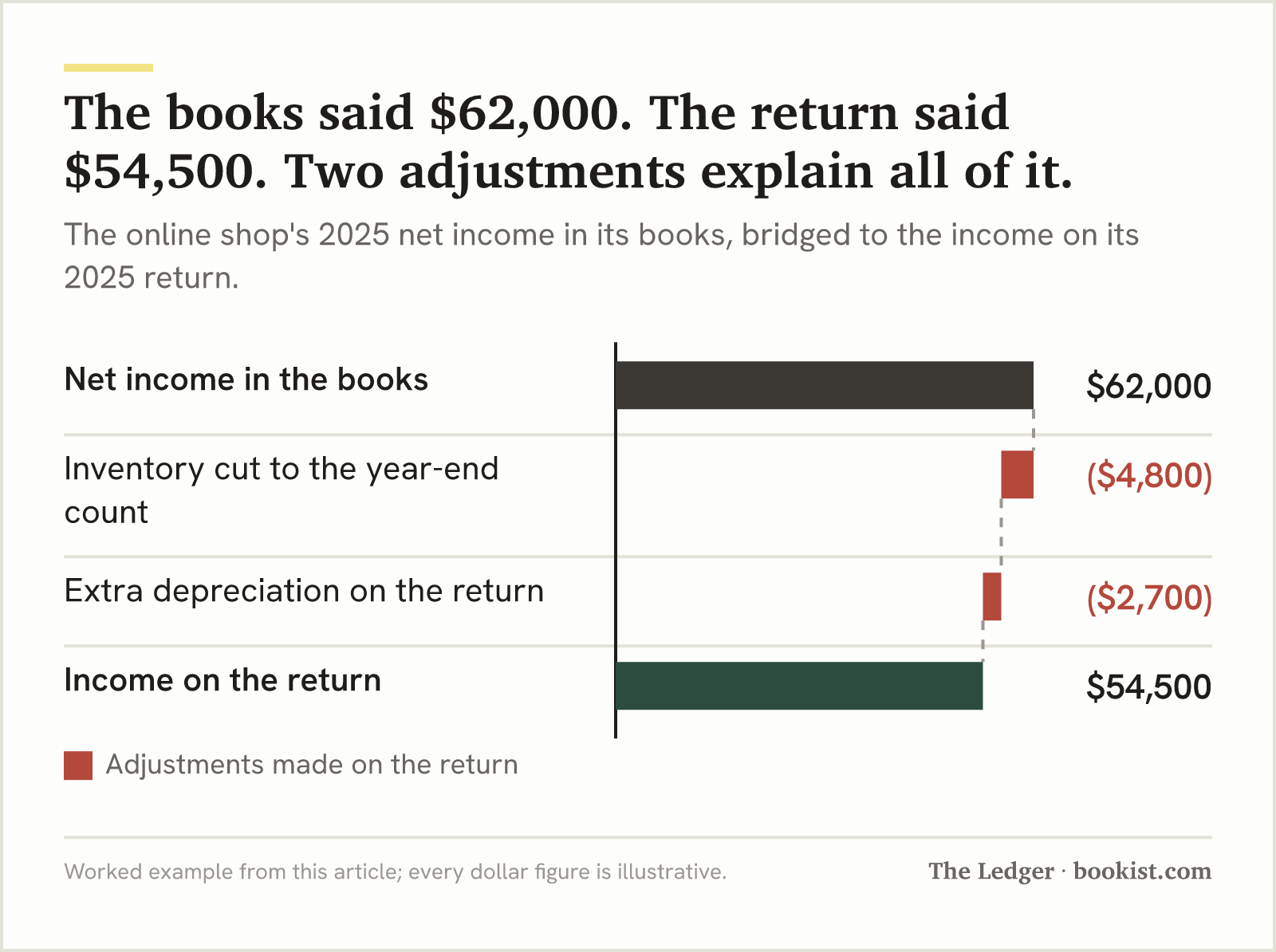
Two of the three checks failed on the first run, and neither was a sign of anything wrong with the business. Both were records that had not been brought up to date.
The shop's 2025 profit and loss showed net income of $62,000. Its 2025 return showed $54,500. The $7,500 difference was two things the preparer had done in March and nobody had posted back to the books: a $4,800 reduction in inventory after the year-end count came in lower than the books said, and $2,700 of extra depreciation the return took on a new packing station that the books were spreading over several years.
Check | What the shop's package showed | What it took to settle |
|---|---|---|
2025 net income against the 2025 return | $62,000 in the books, $54,500 on the return | The $4,800 inventory adjustment posted to the books, and a one-line note for the $2,700 of depreciation, which stays different by design |
Cash on the October 31 balance sheet against the bank | $41,250 in both | Nothing |
Van loan on the balance sheet against the lender's statement | $26,300 in the books, $18,900 on the statement | The $7,400 of 2026 principal that had been coded as an expense, moved back to reduce the loan |
The loan line is the one that would have cost the most. A loan balance that has not come down while payments went out tells a lender the books are coding the whole payment as an expense, and that distorts the debt service coverage ratio a lender computes from these same statements as well as the balance sheet.
After an afternoon of corrections the shop sent the same documents it would have sent anyway. The difference was that each one agreed with the others.
Put last year's net income beside the return, your balance sheet cash beside the bank statement for the same day, and each loan balance beside the lender's latest statement. Write down any gap and who can explain it. Those three comparisons are most of what a lender will check first, and every one of them can be settled before you apply.
What documents do I need for an SBA 7(a) loan?
The same financials, plus SBA forms for the business and its owners, and the lender completes the SBA side. A 7(a) loan is made by a lender and partly guaranteed by the SBA, so the lender asks for its own list and follows the SBA's rulebook for the program, SOP 50 10, whose version 8.1 took effect on October 1, 2026.
Three SBA documents are the ones an owner fills in or signs.
SBA document | What it is | Who completes it |
|---|---|---|
Information about the applicant business and its owners for a 7(a) loan request | The business and its owners, with the lender | |
What an owner owns and owes, which the SBA uses to assess applicants for 7(a) and 504 loans | Each owner the lender names | |
A personal guarantee of the loan | Each individual who owns 20% or more of the business |
The guarantee is the line to read twice. Under the SBA's guarantee form, an individual who owns 20% or more of the business applying must give an unlimited personal guaranty, which means that owner personally guarantees payment of everything owed on the loan. That is a consequence to understand before the application, and how it sits with your own finances is a question for your own advisers.
Whether the numbers support borrowing at all is a conversation with your accountant and the lender. What this article covers is making sure the package shows the real numbers when that conversation starts.
What if my books are not up to date?
Bring them up to date before you cut any report, and do not send estimates. A year-to-date profit and loss built from an unreconciled bank feed shows what was categorized so far, not what happened, and a lender comparing it with your bank statements will find the gap.
Start from the most recent full year, because that is the one the lender reads first against your return, then this year to date. Once it is current, having someone reconcile it monthly means the next request for the same reports, from a lender, a landlord or your preparer, is a printout rather than another catch-up. And if the return itself is late, talk to whoever files your return first: the lender will want it, and a statement cannot stand in for it.
How many months of bank statements do lenders want for a business loan?
The lender sets the number, so ask before you download anything. Whatever the count, send complete statements for every business account, every page, and make sure the closing balance on the last one matches the cash on the balance sheet you send with it.
Do I need a business plan to get a business loan?
Ask the lender, because it depends on the loan and on how long the business has been running. If you write one, start every projection from this year's actual year-to-date results, so the plan and the statements describe the same business.
Do lenders ask for articles of incorporation or a certificate of good standing?
They can, and the reason is identity rather than finances. The lender needs to know the business exists under the exact name on the application, who owns it in what shares, and that it is current with the state where it is registered. Check before you send them that the legal name on those papers matches the name on your returns and your bank account.
Statements that agree with your returns before the lender looks
If last year's profit did not match the return and nobody could say why, or a loan balance on your balance sheet has not moved in months, that is a bookkeeping question rather than a lending one. We are glad to look at it with you, including whether anything needs to change at all.
This article explains how lending documentation generally works. It is not financial, legal or tax advice for your situation.
Operations background across retail, property management, and e-commerce. Writes step-by-step guides for owners who need the answer, not the theory.