Which of my finance tasks need a bookkeeper vs accountant vs CPA?
A bookkeeper keeps the month and an accountant builds the year. The legal line sits elsewhere: only a CPA, an enrolled agent or an attorney can represent your business in every IRS matter.

Only a CPA, an enrolled agent or an attorney has unlimited rights to represent a business before the IRS, including audits, collection and appeals.
Anyone paid to prepare a federal tax return needs a PTIN, and a preparer with only a PTIN may prepare the return but cannot represent the business before the IRS on returns prepared after 2015.
Under the IRS's PTIN guidance, a bookkeeper who records and organizes the information while the preparer makes the tax determinations is not a tax return preparer.
Bookkeeper vs accountant comes down to when the work happens. A bookkeeper keeps the record every month. An accountant turns a finished year of that record into a return, adjusted statements and advice. Only one line is legal rather than customary: if the IRS audits your business, only a CPA, an enrolled agent or an attorney can represent it in every kind of matter.
So there are two questions for each task on your list: who usually does it, and who is allowed to. Most comparisons answer only the first. The second is where an owner ends up paying an accountant's rate for monthly categorizing, or finds out in the middle of an IRS notice that the person who prepared the return cannot speak for the business.
The examples below follow a four-person online shop selling coffee equipment, run as an S corporation. The business is illustrative. The rules are the IRS's and are linked where they are stated.
What does a bookkeeper do that an accountant usually does not?
A bookkeeper keeps the record current: every transaction categorized, every bank and card account reconciled to its statement, and the month closed so the numbers stop moving. For the coffee shop that means matching each Shopify payout to the orders and fees inside it, recording the payroll provider's journal entry after each pay run, keeping the supplier bills and what is still owed on them, and handing over a profit and loss and balance sheet that tie to the bank.
That is work done twelve times a year, close to the transactions, while somebody still remembers what a charge was for. What it should produce each month is set out in what a bookkeeper should be handing you every month.

The IRS draws a useful line here. Its PTIN frequently asked questions, read in October 2026, describe a bookkeeper who gathers receipts and invoices and organizes and records the information for the return preparer, who makes the substantive tax determinations. That bookkeeper is not a tax return preparer and does not need a preparer tax identification number (PTIN). Recording is bookkeeping. Deciding what the record means for the tax owed is preparation.
What does an accountant do with the books once they are kept?
An accountant works on the year rather than the month. The year-end adjusting entries, depreciation on the espresso machines the shop bought for its demo counter, the reclassifications that make the books match the return, the return itself, and the tax planning conversation about next year all sit here. An accountant also prepares financial statements for a lender in the form the lender asks for.
The handoff between the two is the year-end package: a reconciled year, the fixed asset purchases with their invoices, the loan statements and the payroll reports. What belongs in it, and what an accountant should never have to chase, is in what to give your accountant for taxes.
The word "accountant" on its own does not tell you which credential someone holds. A CPA is licensed by a state board of accountancy after passing the Uniform CPA Examination, and an enrolled agent is licensed by the IRS after a three-part exam, according to the IRS's page on tax return preparer credentials and qualifications, read in October 2026. Ask which one the person you are paying holds, because the next two sections turn on it.
Who is allowed to prepare my business tax return?
Anyone who is paid to prepare all or substantially all of a federal tax return must have a PTIN, and the IRS's preparer credentials page says any tax professional with a PTIN is authorized to prepare federal tax returns. The IRS's PTIN frequently asked questions, read in October 2026, add that CPAs and attorneys need a PTIN only if they prepare returns for compensation.
So preparing the return is not reserved to CPAs. A preparer with a PTIN and no other credential may legally prepare your S corporation's return for a fee. What differs between that preparer and a CPA is what happens after the return is filed.
Who can represent my business if the IRS audits it?
Only a CPA, an enrolled agent or an attorney has unlimited rights to represent a business before the IRS, audits, collection and appeals included. That is the IRS's own statement on its preparer credentials page, read in October 2026.
Below that line the rights narrow quickly. A participant in the IRS Annual Filing Season Program who holds none of those three credentials may represent only on returns they prepared and signed, only before revenue agents, customer service representatives and similar IRS employees, including the Taxpayer Advocate Service, and never in appeals or collection. A preparer with only a PTIN has no authority to represent anyone before the IRS, except on returns they prepared and filed on or before December 31, 2015.
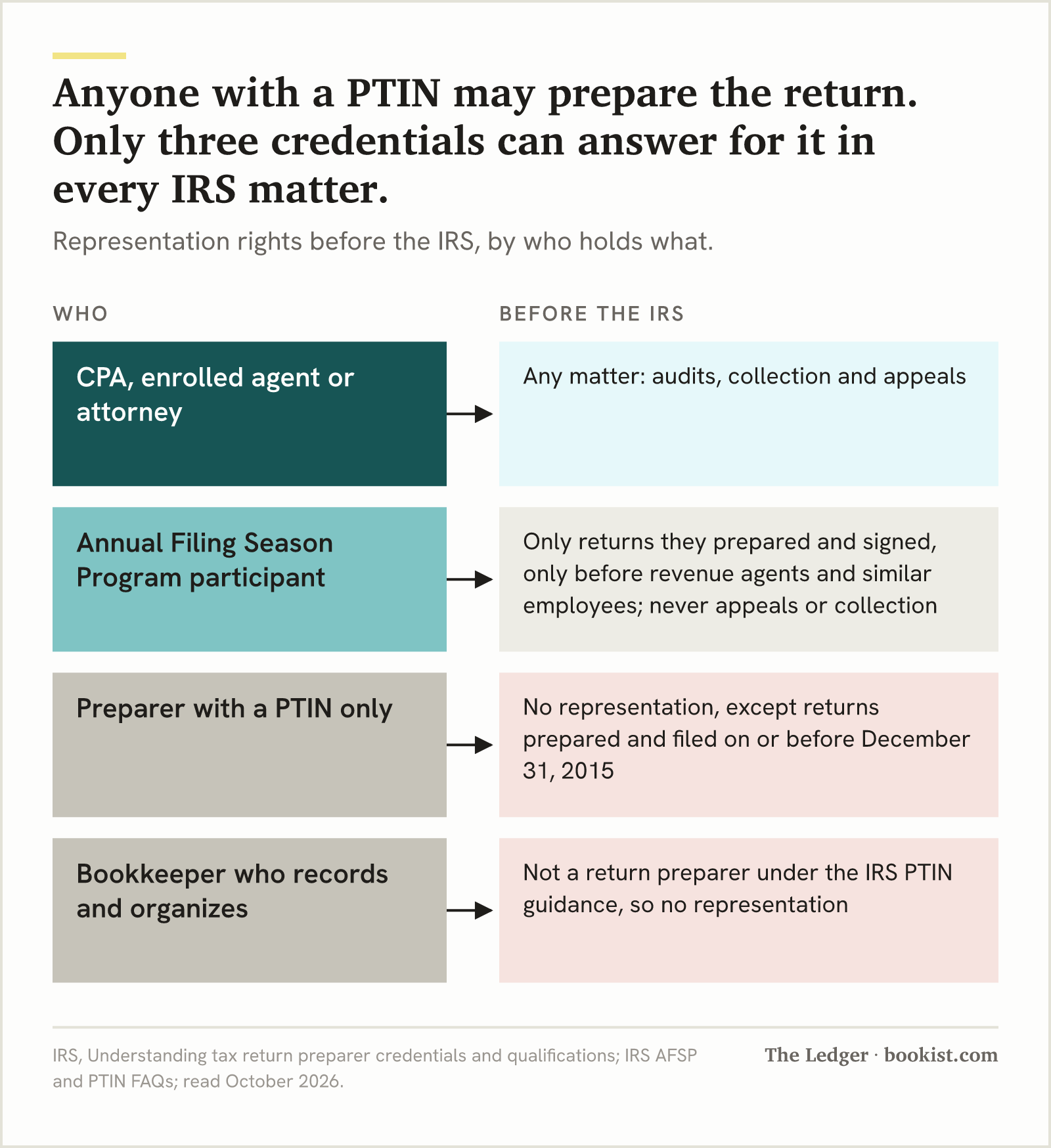
Who | May prepare your return for pay | May represent your business before the IRS |
|---|---|---|
CPA | Yes, with a PTIN if paid to prepare | Any matter: audits, collection, appeals |
Enrolled agent | Yes, with a PTIN | Any matter: audits, collection, appeals |
Attorney | Yes, with a PTIN if paid to prepare | Any matter: audits, collection, appeals |
Annual Filing Season Program participant | Yes, with a PTIN | Only returns they prepared and signed, only before revenue agents, customer service representatives and similar employees; never appeals or collection |
Preparer with a PTIN only | Yes | No, except returns prepared and filed on or before December 31, 2015 |
Bookkeeper who records and organizes, without making the tax determinations | Not a return preparer under the IRS's PTIN guidance | No |
The question to ask before you hire is not who will prepare the return. It is who can answer for it when the IRS writes back.
For the coffee shop, the practical consequence is timing. If the return was prepared by someone in the second-to-last row and a notice arrives about it, the business either answers the notice itself or brings in a CPA, an enrolled agent or an attorney who is seeing the file for the first time.
Who has to sign reviewed or audited financial statements?
Reviewed and audited financial statements come from a licensed CPA firm. The Uniform Accountancy Act, the model law NASBA and the AICPA publish for state boards of accountancy (Ninth Edition, 2025), bars anyone without a license from performing audits or reviews of financial statements or issuing reports on them, and routes that work through firms that hold a permit. Each state adopts its own version, so your state's accountancy act is the rule that actually applies.
If a lender or a landlord asks for reviewed statements, the review starts from the books you already have. A year of unreconciled months is the first thing the engagement has to fix.
Which of my finance tasks belongs to which role?
Each task on an owner's list belongs to one role by habit and, for a few of them, to one role by law. The table puts both side by side, with what tends to go wrong when the task lands in the wrong place.
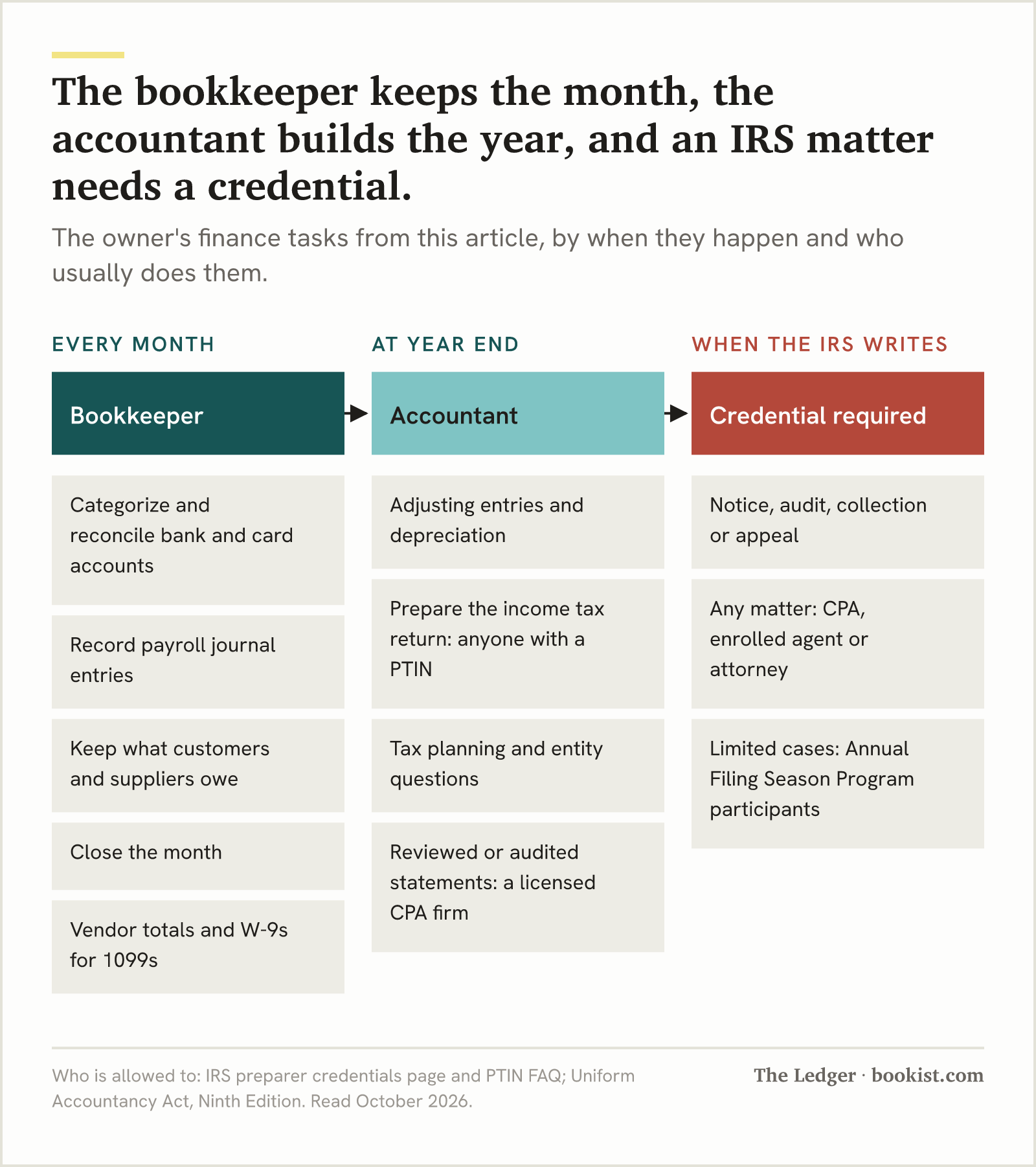
Task | Who usually does it | Who is allowed to | When it lands in the wrong place |
|---|---|---|---|
Categorize transactions and reconcile bank and card accounts monthly | Bookkeeper | No credential in the rules cited here | Done by an accountant once a year, it is billed at year-end rates and the reasons for odd charges are forgotten |
Record payroll journal entries | Bookkeeper, from the payroll provider's reports | No credential in the rules cited here; the payroll itself runs through your provider | Left until year end, the wage accounts and the payroll tax filings disagree and someone reconciles twelve months at once |
Keep the record of what customers owe and what you owe suppliers | Bookkeeper | No credential in the rules cited here | Without it, the balance sheet cannot show what is owed either way, and accrual statements cannot be built |
Close the month | Bookkeeper | No credential in the rules cited here | Skipped, every report is provisional and nobody knows which month a late adjustment changed |
Track vendor totals and W-9s for 1099s | Bookkeeper | No credential in the rules cited here; the business is the filer | Done in January from memory, the wrong payments get counted |
Year-end adjusting entries and depreciation | Accountant | No credential in the rules cited here | Done by a bookkeeper without the tax return in view, the books and the return disagree |
Prepare the income tax return for pay | Accountant, CPA or enrolled agent | Anyone with a PTIN | Prepared from books that were never closed, the return carries the books' errors |
Answer an IRS notice, audit, collection or appeal | CPA, enrolled agent or attorney | CPA, enrolled agent or attorney in any matter; Annual Filing Season Program participants in limited cases | The person who knows the return cannot represent it, and a new representative starts from the file |
Reviewed or audited financial statements | CPA firm | Licensed CPA firm, under your state's accountancy act | Asked for at short notice, they wait on books that were never reconciled |
Tax planning and entity questions | Accountant, CPA or enrolled agent | No credential in the rules cited here | Asked of a bookkeeper, it is outside the work they are paid for; asked at filing time, it can only describe a year that has already ended |
The 1099 row is the one that sits across both lanes. The record of who was paid, how much and by what method lives in the books all year, and which of those payments count toward the reporting threshold is set out in the part of each vendor's total that counts toward the 1099 threshold.
Which bookkeeper and accountant setup fits a business my size?
At $250,000 to $5 million in revenue with nobody in-house doing finance, three setups are common. Each one fits some businesses and is wrong for others.
Setup | What it covers | Who it is wrong for |
|---|---|---|
You keep the books; a CPA firm does the return and nothing else | Compliance once a year, from whatever the books hold in January | Anyone who needs a monthly number they trust before they decide on stock, hiring or a loan, and anyone whose year-end package turns into a cleanup every spring |
A part-time or outsourced bookkeeper monthly; a CPA or enrolled agent at year end | A closed month, every month, and a return prepared from books that already tie | Anyone who has tax questions mid-year and only talks to the accountant at filing time; the questions need to be scheduled, not saved |
Bookkeeper and accountant, plus an occasional fractional CFO | The record, the return and forward planning | Anyone whose books are not yet reliable monthly; a CFO reading unreconciled numbers is planning from the wrong starting point |
The second setup is where Bookist sits: the monthly books kept and reconciled, with automation doing the first pass and a human accountant reviewing it. Bookist does not prepare your return or represent you before the IRS. That stays with your CPA or enrolled agent. What each part of the work costs depends on how much of it there is, and what bookkeeping costs is set out on the pricing page rather than here.
Look up whoever prepared last year's return in the IRS's public directory of federal tax return preparers, which lists CPAs, enrolled agents and attorneys who hold a PTIN, and Annual Filing Season Program participants. Then list every finance task someone did for you last year beside who did it. Any task done once a year that the table puts in the monthly column is the first one to move.
Do I need an accountant for my small business if I have a bookkeeper?
A bookkeeper does not replace an accountant, a CPA or an enrolled agent for the year-end work: adjusting entries, depreciation and the income tax return. The bookkeeper keeps the record the return is built from. The IRS's PTIN guidance treats a bookkeeper who only records and organizes the information as someone who is not preparing the return. If the IRS later questions that return, only a CPA, an enrolled agent or an attorney can represent the business in every kind of matter.
Is bookkeeping the same as accounting?
Bookkeeping is the part of accounting that records transactions and keeps the accounts reconciled. Accounting is the wider work of adjusting that record at year end, preparing statements and returns from it, and advising on what it means. A business can do its own bookkeeping and still pay an accountant, and when it pays both it is paying for two different jobs.
Should I hire a bookkeeper or an accountant first?
Hire for the gap you have now. If the books are not reconciled every month, a bookkeeper fixes the problem the accountant would otherwise inherit at year end. If the books are current and the question is the return, an entity change or an IRS notice, that is an accountant's work, and for an IRS matter it needs a CPA, an enrolled agent or an attorney. Which credential fits your return depends on your entity and your history, and it is worth ten minutes with whoever files your return before you change who does what.
A clear line between your bookkeeper's work and your accountant's
If you are deciding who should keep the books every month and who should only see them at year end, bring last year's task list and we will walk through where the line falls for your business. Your return and anything the IRS sends stay with your CPA or enrolled agent.
This article explains how the federal rules on preparing returns and representing a business before the IRS generally work, and how the model accountancy act treats audits and reviews. It is not tax or legal advice for your situation. </content>
Has migrated more companies off legacy accounting systems than he'd like to admit. Reviews the tools, integrations, and duct tape holding modern finance stacks together.