What a fractional CFO does beyond your bookkeeper's monthly close
Your bookkeeper's reports answer what happened last month. A fractional CFO plans the months ahead from those same reports, which is why the books come first and the forecast second.

A fractional CFO is a part-time senior finance person who plans the months ahead, such as hiring, pricing, loan covenants and cash forecasts, working from the books a bookkeeper keeps rather than keeping them.
Questions about the month that just ended, such as whether it was profitable or why profit and cash differ, are answered by a bookkeeper's monthly reports without a CFO.
If the monthly reconciliations and statements are not finished and trusted, a fractional CFO's forecast starts from the wrong numbers, so the books are fixed first.
A fractional CFO is a part-time senior finance person who works on decisions about the months ahead: whether you can afford the next hire, what a price change does to cash, whether a loan's terms will hold, how much money will be in the bank in 13 weeks. They work from the books your bookkeeper keeps. They do not keep them.
That gives you the test for whether you need one, and it is not your revenue. It is the decision in front of you. Some of the questions owners take to a fractional CFO are already answered by the reports a bookkeeper hands over every month. Others need a forecast, which is work a bookkeeper is not doing. And a few need the books fixed before anyone can answer them at all.
The examples below follow an 11-person company that sells soil-moisture sensors and a monitoring subscription to farms and vineyards, with about $1.8 million in revenue last year. The business and its numbers are illustrative.
What does a fractional CFO do each month?
A fractional CFO turns last month's closed books into a view of the next few months, and then sits with you while you decide what to do about it. The Bureau of Labor Statistics describes financial managers, the occupation whose experienced members move up into the CFO role, as people who create financial reports, direct investment activities and develop plans for the long-term financial goals of their organization. A fractional one does the planning part of that for several businesses at once, for a set number of hours each.
The recurring work is a handful of outputs, and these are the ones to ask about:
A cash forecast, for example week by week for the next quarter, rebuilt each month from what actually happened.
A budget for the year, and a monthly comparison of the actual results against it.
Models for specific decisions: a hire, a price change, a new contract, a large purchase.
The numbers a lender or investor asks for, including any ratio a loan agreement requires you to keep.
A standing meeting with you to go through all of it.
None of that list is a legal definition, and engagements vary. That is why the list is useful: it is what to ask a candidate to put in writing, so you know what a normal month of the work looks like before you pay for one. What an engagement costs depends on its scope and the hours in it, so ask for a scoped proposal rather than a rate.
Which decisions need a fractional CFO, and which does my monthly package already answer?
Questions about the month that just ended are answered by your monthly package. Questions about the months ahead need a forecast. Each row below is a decision an owner in your position faces, with who answers it and what has to be true in the books first.
The monthly package is the set of reports a bookkeeper should hand over after each close: reconciliations, a profit and loss, a balance sheet and the aging reports. If you are not sure you are getting all of it, what a bookkeeper should hand you every month lists each report and how to check it arrived.
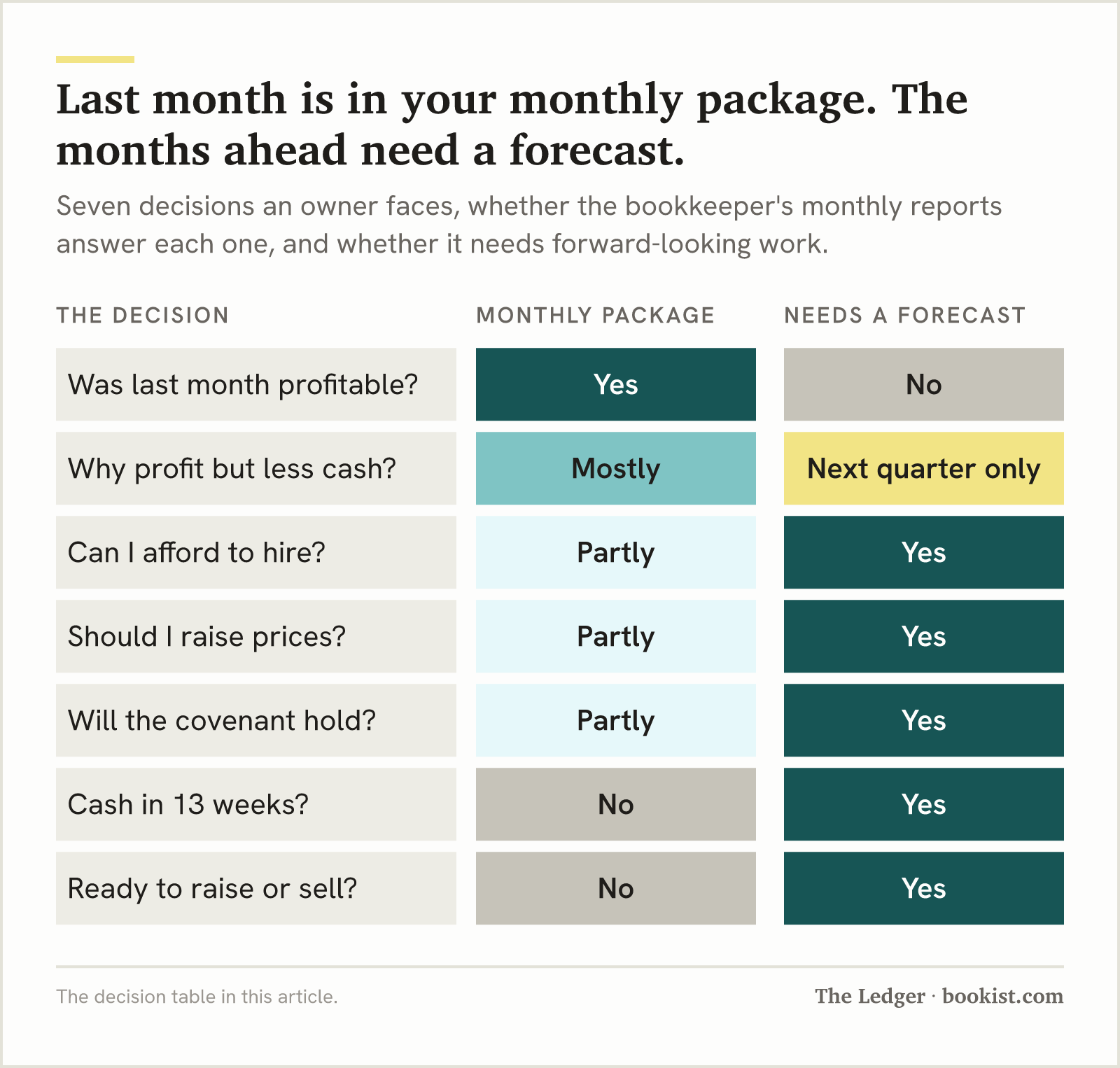
The decision or question | Does the monthly package answer it? | Does it need forward-looking work? | What has to exist in the books first |
|---|---|---|---|
Was last month profitable? | Yes. The profit and loss for the closed month | No | Every bank and card account reconciled, and the month closed |
Why do I have profit but less cash? | Mostly. The balance sheet and a short bridge from profit to cash explain it | Only if you need to know what happens next quarter | Loan, receivable and payable balances that tie to their statements |
Can I afford to hire? | Partly. It shows what payroll costs you today | Yes. The new salary against forecast cash, month by month | Payroll recorded so the cost of delivering the work is separate from overhead |
Should I raise prices? | Partly. It shows your margin, if revenue and direct costs are split by product or service | Yes. What happens to volume and cancellations at the new price | Revenue and direct costs split the way you sell |
Will this loan's covenant hold? | Partly. Today's ratio can be worked out from current statements | Yes. Testing the ratio quarter by quarter through the forecast | Loan balances that agree with the lender's statements, interest split from principal |
How much cash will I have in 13 weeks? | No | Yes. A week-by-week cash forecast | Current receivables and payables, with the dates money is due |
Am I ready to raise money from investors or sell the business? | No | Yes. Projections, the conversations around them, and preparing for an outside review of the books | Several years of closed, consistent statements |
The profit-but-less-cash row is a question the books can answer on their own. The gap is usually loan principal, owner draws, equipment and sales tax, which leave the bank without touching profit, and a budget vs actual reconciled to the cash that left your account shows it in a few lines.
A fractional CFO works from the books a bookkeeper keeps. If the monthly reconciliations and statements are not finished and trusted, the forecast starts from the wrong numbers.
What does that look like in a business like mine?
The sensor company has three decisions to make before spring. The owner wants two field installers on the payroll before planting season, because that is when growers want sensors in the ground. The bank has offered a line of credit with a covenant: a minimum debt service coverage ratio, tested every quarter. And the subscription price has not changed in two years.
The monthly package answers the first half of each. It shows last quarter's profit, what payroll costs now, and today's cash. It does not show whether cash in April covers two more salaries while growers pay on 60-day terms, whether the ratio still clears the covenant in the quarter the installers start, or how many subscribers a higher price would lose. Those are forecasts, and each one is a fractional CFO's question.
Before any of them can be answered, the books have a problem. Growers pay for the monitoring subscription a year in advance, and the bookkeeping has been recording each payment as revenue in the month the cash arrived. So winter months show revenue that has not been earned yet, and spring months look weaker than they are. A forecast built on those months would expect cash the business had already collected. The fix is a bookkeeping change: record the prepayment as money owed in service and release it month by month as the service is delivered. Until that is done, every forecast inherits the error.
That is the order in a sentence. Fix what the books say about the past, then pay someone to plan the future from them.
When are a bookkeeper and a CPA enough?
A bookkeeper and a CPA are enough while the decisions in front of you are about what already happened. That means whether the month was profitable, what you owe in tax, and why cash moved the way it did. The first two rows of the table above are monthly-package questions, and a business that only ever asks those does not need a forecast built for it.
Two other situations also point to not yet. One is a decision that comes up once: a single loan application or one large purchase can be modeled as a short project rather than an ongoing engagement. The other is books that are not closed on a schedule. A CFO hired then spends the first months of the engagement on cleanup, at a CFO's rate. How the record, the return and forward planning divide between roles is set out in which finance tasks need a bookkeeper vs accountant vs CPA.
The setup is wrong the other way round when the forward questions keep arriving. If you are deciding on hires, prices, contracts or borrowing most months, and answering them from the bank balance and instinct, that is the gap a fractional CFO fills.
What has to be in place before a fractional CFO starts?
Closed, reconciled months, statements you trust, and books split the way your decisions are made. A CFO plans from those, so they come first:
Every bank, card and loan account reconciled to its statement, every month, with the month closed so it cannot quietly change afterward.
A balance sheet where each line ties to something outside the books: the bank, the lender, the aging reports.
Revenue and direct costs split by the lines you actually decide about, such as product, service or location.
Prepayments, deposits and annual contracts recorded as money owed in service until they are earned.
Twelve months of those closed months, so the forecast has a real seasonal shape to start from.
The last point matters more than it looks. The SBA's business plan guidance asks an established business for its last three to five years of income statements, balance sheets and cash flow statements alongside its projections. A forecast is only as believable as the history it extends.
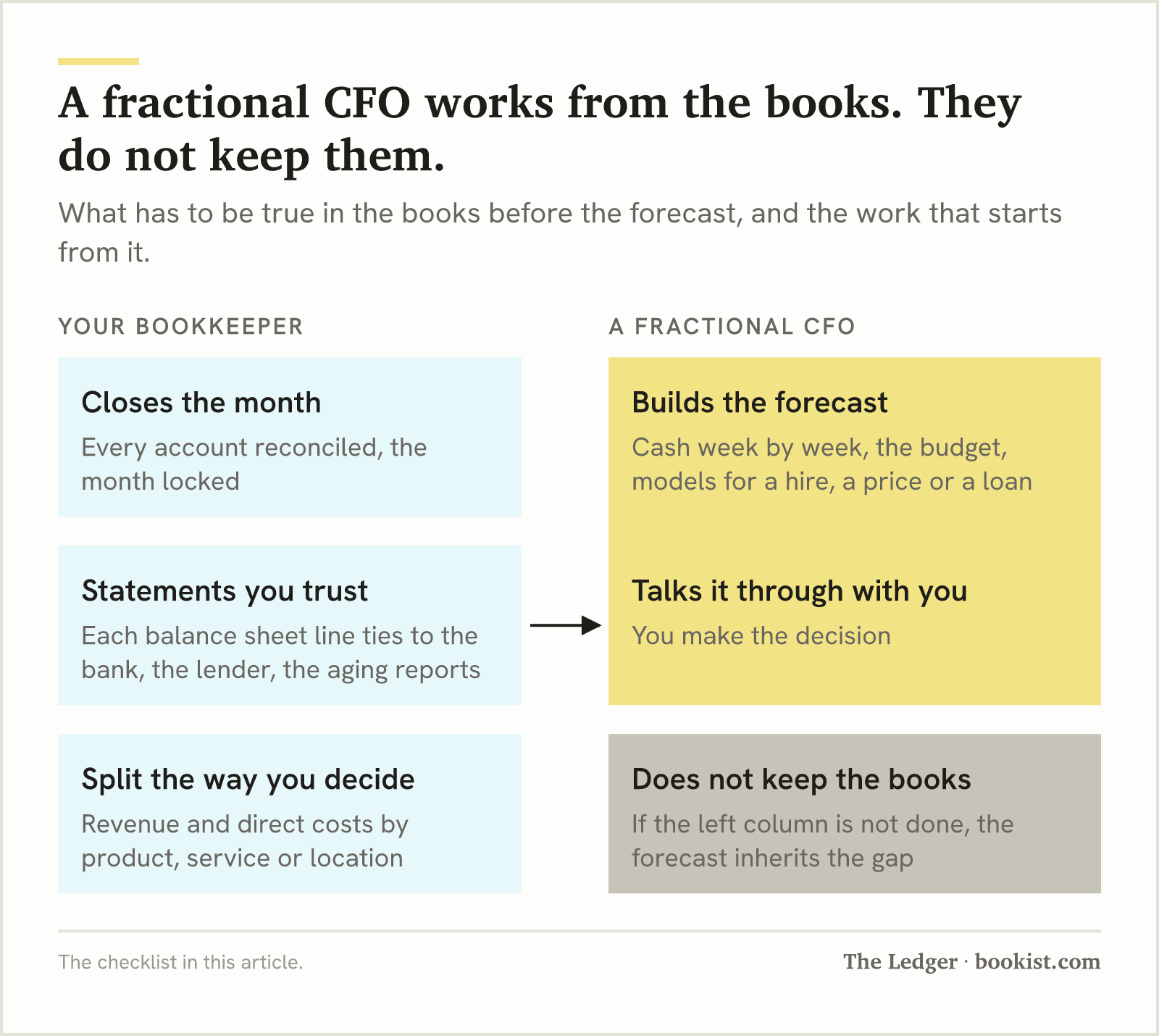
Most of this list is your bookkeeper's work. Point 3 is usually a setting rather than a project: QuickBooks Online calls it class tracking and Xero calls them tracking categories, according to each company's help pages as read in October 2026. Ask your bookkeeper which of the five are already true, and how long the rest would take.
Bookist sits on this side of the line. It keeps the monthly books reconciled and closed, with automation doing the first pass and a human accountant reviewing it, and what keeping the books costs is on the pricing page. Bookist does not forecast, advise on decisions or act as your CFO. Those stay with whoever you hire for them.
What should I ask a fractional CFO before hiring one?
Ask what you will receive each month, what they need from your books, and who fixes the books if they are not ready. Good answers are specific and come in writing.
Ask | What a good answer sounds like |
|---|---|
What will I receive each month, and in what form? | A named list: a cash forecast, a budget comparison, any covenant calculations, and a meeting date |
Which of my decisions will you work on first? | The ones you named, in an order they can explain |
What do you need from my books before you start? | Closed months by a date, reconciliations, and the splits your decisions need |
If my books are not ready, who fixes them? | Your bookkeeper, with the CFO saying exactly what needs to change, or a separately scoped cleanup |
Will you keep the books, or work from my bookkeeper's? | Work from them. A CFO keeping the books means paying a planning rate for recording work |
How do you hand off to my CPA for tax? | A clear line: they plan, your CPA prepares the return |
How is the work scoped, and what happens when the scope changes? | Hours or deliverables stated up front, and a change agreed before it is billed |
Who owns the forecast model if we stop? | You do, in a file you can open |
List the three money decisions you expect to make in the next six months. Beside each, write whether last month's reports already answer it. A decision left blank is the scope of a fractional CFO conversation, and one where the reports exist but you do not trust them is a conversation with your bookkeeper first.
What is the difference between a fractional CFO and a controller?
A controller runs the reporting and a CFO runs the planning. The Bureau of Labor Statistics describes controllers as directing the preparation of financial reports that summarize and forecast the organization's financial position, so the two overlap on forecasting. In a business with no finance staff, a controller makes sure the books and reports are right and on time, and a fractional CFO uses them to decide what to do next.
How is a fractional CFO different from a full-time CFO?
A fractional CFO does the same kind of planning work as a full-time CFO, for a set number of hours a month, usually for several businesses at once and from outside the company. A full-time CFO is an employee whose whole job is your business, and that only makes sense once there is a full-time role's worth of decisions to make. Either one works from books someone else keeps.
When should a small business hire a fractional CFO?
Hire a fractional CFO when the decisions you keep facing are about the future and your monthly books are already closed and trusted. Hiring, pricing, borrowing against a covenant, a cash forecast for the next quarter, and raising money or selling are forward-looking decisions. If the books are not closed on a schedule, fix that first, because a CFO's forecast can only extend the numbers it is given.
Monthly books a forecast can stand on
If you are weighing a fractional CFO and are not sure your monthly numbers are ready for one, we can go through your last few closes and what a forecast would need from them. Bookist keeps the books. The forecasting and the advice stay with whoever you hire for them.
This article explains how the roles generally divide and what a forecast needs from the books. It is not financial, tax or lending advice for your situation.
Has migrated more companies off legacy accounting systems than he'd like to admit. Reviews the tools, integrations, and duct tape holding modern finance stacks together.